Rare Pikachu Cards: What Makes a Pikachu Card Valuable?
Why are some Pikachu cards worth dramatically more than others? This guide explains how scarcity, release history, condition, grading and collector demand shape the value of rare Pikachu cards.

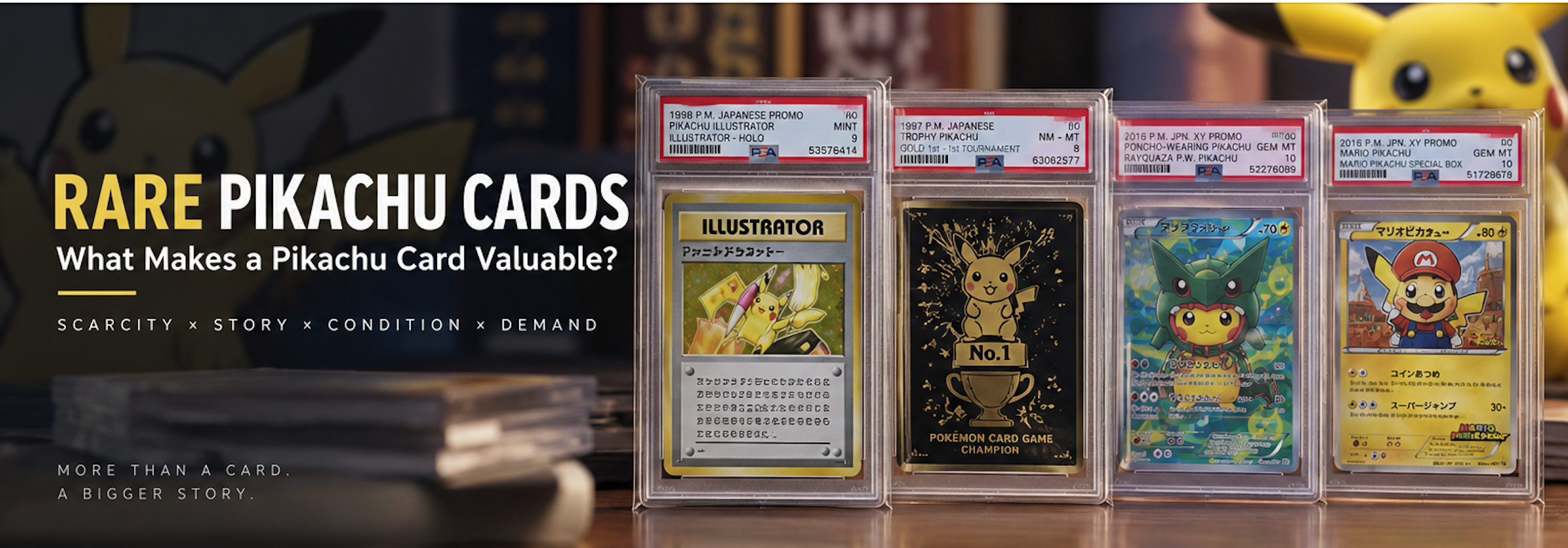
Two Pikachu cards can feature the same character, come from similar eras, and look equally impressive in a display case—yet collectors may treat them completely differently.
One might be an inexpensive card produced in large numbers.
Another might have been distributed only through an illustration contest, awarded at a competitive event, included in a short-lived Japanese product, or preserved in remarkably few high-grade examples.
So what actually makes a Pikachu card rare?
And why do some rare Pikachu cards become highly valuable while others remain relatively affordable?
We think the best way to answer that question is not with a simple "Top 10 Most Expensive Pikachu Cards" list.
Instead, we evaluate Pikachu cards through four factors:
Scarcity × Story × Condition × Demand
A card becomes especially compelling when several of those factors overlap.
This guide explains that framework, looks at notable Pikachu cards collectors should know, and shows you how to evaluate rarity and value without relying on hype, asking prices, or a single headline auction result.
What Makes a Pikachu Card Rare?
When collectors hear the word "rare," they often think about the rarity symbol printed on a Pokémon card.
That can be useful when comparing normal cards within a set.
It becomes much less useful when studying Pikachu.
Many of the most interesting Pikachu cards were not ordinary booster-pack pulls at all.
They came from:
- Illustration contests
- Competitive events
- Pokémon Center campaigns
- Special boxes
- Regional promotions
- Anniversary programs
- Collaborations
- Limited product releases
That leads to our first important principle:
For promotional Pikachu cards, distribution rarity can matter more than printed rarity.
A card doesn't need the rarest symbol in an expansion if only a limited group of people ever had an opportunity to obtain it.
Limited Distribution
When evaluating an unfamiliar Pikachu card, ask one question first:
How did someone originally get this card?
There is a major difference between:
- opening a widely available booster pack,
- purchasing a special product available for a limited period,
- attending a particular event,
- entering a contest,
- or placing in a tournament.
The narrower the original path to ownership, the more interesting the card may become from a scarcity perspective.
But limited distribution still does not guarantee value.
A scarce card also needs people who want it.
That distinction—between scarcity and demand—runs throughout this guide.
Promotional Releases
Pikachu has an unusually deep history of promotional cards.
That's one reason Pikachu collecting can become more complicated than simply learning rarity symbols.
But "promo" is not a meaningful rarity category by itself.
One promotional card might have been distributed in very large numbers.
Another might have been available only through a specific campaign or event.
Both are promos.
Their collectible profiles can be completely different.
So rather than asking:
Is this a promo?
we think collectors should ask:
What was the distribution mechanism?
That question usually tells you much more.
Japanese and Regional Releases
Japan plays an especially important role in Pikachu collecting because many distinctive Pikachu releases originated through Pokémon Centers, special products, events, and collaborations.
Poncho-wearing Pikachu cards are a good example. Various versions appeared through Japanese promotional products during the XY era, including designs inspired by Charizard and Rayquaza.
Mario Pikachu and Luigi Pikachu are another example. They were released through dedicated Japanese Special Boxes in 2016, combining Pikachu with another instantly recognizable Nintendo-associated world.
But "Japanese" should never be treated as a synonym for "valuable."
The useful question isn't:
Is it Japanese?
It's:
Which Japanese release is it, how was it distributed, and how much collector demand exists for that exact card?
Language is context.
Distribution is often the real clue.
Age and Survival
Older cards can develop another type of scarcity:
survival scarcity.
A card may originally have existed in meaningful numbers but become difficult to find in excellent condition decades later.
Cards were:
- played,
- traded,
- placed in pockets,
- stored without protection,
- scratched,
- bent,
- or simply lost.
So age can contribute to what we call:
condition scarcity
That is different from original print scarcity.
And for collectors of graded Pokémon cards, the distinction matters enormously.
Our Four-Factor Framework for Pikachu Card Value
Instead of asking whether a Pikachu card is simply "rare," we prefer evaluating four dimensions.
Scarcity × Story × Condition × Demand
None of these factors works perfectly in isolation.
Together, they give you a much clearer picture of why certain Pikachu cards stand apart.
1. Scarcity — How Difficult Is the Card to Obtain?
Scarcity can come from several places:
- Limited original distribution
- Short availability window
- Competition placement
- Regional exclusivity
- Low surviving supply
- Low high-grade population
But the mistake is assuming that every kind of scarcity has equal value.
Imagine two cards.
One has only 100 surviving examples but almost no active collector demand.
Another has 5,000 surviving examples but tens of thousands of collectors actively searching for it.
The second card can still develop the stronger market.
Scarcity becomes powerful when demand meets it.
2. Story — Why Does This Card Matter?
This is the factor we think many card-value articles underestimate most.
Collectors do not only collect scarce pieces of cardboard.
They collect stories attached to cardboard.
A card might represent:
- an early Pokémon event,
- an illustration contest,
- a Pokémon Center campaign,
- an unusual collaboration,
- an anniversary,
- an important competitive event,
- or a memorable era of the franchise.
Consider Pikachu Illustrator.
It was awarded through illustration contests conducted in Japan rather than released through ordinary retail distribution.
That makes it an illustration-contest award card, not simply another rare Pikachu printing.
Its collectible appeal therefore comes from more than low supply.
It represents a particular chapter in early Pokémon history.
That story cannot be recreated simply by printing similar artwork again later.
A reprint can reproduce an image.
It cannot reproduce the original distribution event.
3. Condition — How Rare Is the Card in High Grade?
This is where grading adds a second layer of scarcity.
Imagine 2,000 copies of a particular Pikachu card survive.
That does not sound extremely scarce.
But what if very few of those copies remain in Gem Mint condition?
Now there are two separate questions:
How rare is the card?
and
How rare is the card in this condition?
Those are not the same thing.
A card can be relatively obtainable raw while being much harder to find in PSA 10.
That is one reason high-grade premiums sometimes become much larger than beginners expect.
If you're still learning how professional card grading works, our PSA Graded Pokémon Cards guide explains grading, slabs, condition, and population in more detail.
4. Demand — How Many Collectors Actually Want It?
Demand completes the picture.
A card can have:
- low supply,
- an interesting distribution method,
- and excellent condition,
but if very few collectors care about it, the market may remain small.
Pikachu has an advantage because the character attracts collectors across multiple generations and regions.
But even that does not make every Pikachu card valuable.
There are many Pikachu releases.
The exact card still matters.
Our framework therefore isn't:
Pikachu + rare = expensive.
It's:
Scarcity + meaningful story + desirable condition + sustained demand = stronger collectible profile.
Rare vs Valuable vs Expensive Pikachu Cards
These words are often treated as if they mean the same thing.
They don't.
| Term | What It Actually Means |
|---|---|
| Rare | Difficult to obtain or limited in supply |
| Valuable | Collectors currently assign meaningful market value to it |
| Expensive | Its asking price or transaction price is high |
| Condition-rare | Few examples exist at a particular grade or condition level |
A rare card might not be valuable.
A valuable card might not be exceptionally rare.
An expensive asking price might not reflect a real transaction.
And a card that is relatively common raw may still become expensive in PSA 10 if Gem Mint examples are unusually difficult to find.
Rarity describes supply. Value describes the market's response to supply.
That distinction is one of the most useful things a Pikachu collector can learn.
Rare Pikachu Cards Collectors Should Know
Rather than ranking Pikachu cards only by price, it is more useful to understand why certain cards became important.
Different cards demonstrate different combinations of scarcity, story, condition, and demand.
Pikachu Illustrator
Pikachu Illustrator is one of the clearest examples of all four factors working together.
It has:
Scarcity — restricted original distribution.
Story — tied to an illustration contest rather than normal retail sales.
Condition scarcity — surviving graded copies exist across different condition levels.
Demand — it is recognized globally among serious Pokémon collectors.
That combination is much more meaningful than simply saying:
"It is rare."
On March 27, 2026, Heritage Auctions sold a PSA 9 Pikachu Illustrator for $1,406,250, establishing a major public-auction result for that grade.
That transaction is worth discussing.
But not because it means every Pikachu Illustrator is permanently "worth $1.4 million."
It tells us:
One specific PSA 9 example changed hands in one verified transaction at that price.
That leads to another rule we use when evaluating high-end cards:
A record sale is evidence—not a permanent price tag.
Early Trophy Pikachu Cards
Early Trophy Pikachu cards represent a different distribution story.
These were connected to competitive Pokémon events and awarded based on tournament achievement rather than illustration contests or normal retail availability.
That distinction matters.
A competition prize card carries a different story from an illustration-contest award card.
Both may be scarce.
But the reason they are scarce—and therefore what collectors are actually buying into—is different.
This is exactly why we think the word "rare" alone is too vague.
A serious collector should understand:
Why is this card rare?
not merely:
How rare is it?
Poncho-Wearing Pikachu
Poncho-wearing Pikachu cards show how modern promotional releases can create strong collector identities.
Various versions appeared through Japanese promotional products in the XY era, featuring Pikachu dressed in designs inspired by Pokémon such as Charizard and Rayquaza.
Why have these cards attracted collector attention?
Not simply because they are Japanese.
They combine:
- Distinctive artwork
- Specific promotional distribution
- Strong Pikachu identity
- Crossover appeal with other popular Pokémon
- A recognizable collecting theme
This is a good example of:
Story amplifying scarcity.
The card is not just difficult to obtain.
Collectors understand what makes it visually and culturally distinctive.
Mario Pikachu and Luigi Pikachu
Mario Pikachu and Luigi Pikachu push the idea of collectible story even further.
Released through dedicated Japanese Special Boxes in 2016, the cards combine Pikachu with the visual identity of Mario and Luigi.
The appeal here is not only Pokémon scarcity.
It is cultural crossover.
Someone can understand why these cards are interesting without knowing every Pokémon rarity symbol or set code.
That matters.
We think strong collectible stories often have a characteristic that gets overlooked:
They are easy to explain.
If a card's significance takes 20 minutes to explain, its collector audience may remain relatively specialized.
If the appeal is immediately recognizable, the potential demand base can become much broader.
Birthday Pikachu
Birthday Pikachu shows why exact release identification matters.
The original Japanese version was distributed through a special calendar-related release in 1998, while later English, Japanese, and anniversary-era versions used different distribution paths.
That means searching:
Birthday Pikachu value
is not enough.
You need to know:
- Which printing?
- Which year?
- Which language?
- Which release?
- Which condition?
Cards with similar artwork or names can belong to very different collectible markets.
This is a recurring problem in Pokémon card valuation.
Card identification comes before price research.
Vintage Pikachu Cards
Vintage Pikachu cards have powerful nostalgia.
But this is where another collecting shortcut often fails:
old = valuable.
Not necessarily.
An older Pikachu card can still be widely available.
A heavily played vintage card can remain affordable.
A less common variant or unusually well-preserved copy can behave very differently.
Age should therefore be treated as:
context
not:
proof of value.
Modern Pikachu Chase Cards
Rare Pikachu collecting is not limited to vintage cards and historical promos.
Modern Pikachu cards can also develop strong collector demand through:
- distinctive artwork,
- difficult pull rates,
- limited products,
- special promotional distribution,
- popular sets,
- or high-grade demand.
Modern and vintage cards simply create scarcity differently.
Vintage scarcity often develops through:
survival + condition
Modern scarcity may rely more heavily on:
distribution + variant + current demand
Neither model is automatically better.
What Actually Drives the Most Valuable Pikachu Cards?
Look closely at highly valuable Pikachu cards and you'll notice something important:
The strongest examples rarely depend on one factor alone.
They often combine several.
Distribution Scarcity
The original route to ownership was limited.
Historical or Cultural Meaning
The card represents something collectors remember or understand.
Visual Recognition
The artwork itself has become recognizable.
Condition Scarcity
High-grade examples are harder to obtain.
Persistent Demand
Collectors continue competing for available examples.
This is why our four-factor framework is more useful than a simple rarity ranking.
Two cards can have similarly small populations while having radically different collector markets.
Most Expensive Sale vs Actual Pikachu Card Value
One of the easiest ways to misunderstand collectibles is to confuse different kinds of price information.
| Price Type | What It Actually Tells You |
|---|---|
| Record sale | A notable historical transaction |
| Recent completed sales | Evidence of current market activity |
| Asking price | What a seller hopes to receive |
| Estimated value | An opinion or model, not a completed transaction |
This becomes especially important at the high end of the Pokémon market.
Imagine one exceptional card sells at auction after aggressive bidding.
That transaction is real.
But it does not automatically establish the value of:
- another grade,
- another copy,
- another condition,
- or even the next sale of the same grade.
Our rule is:
Record sales tell you what happened. Repeated comparable sales tell you more about the market.
The more expensive and illiquid a card becomes, the more important this distinction is.
How to Find the Value of Your Pikachu Card
If you already own a Pikachu card and want to understand its value, don't begin by searching:
Pikachu card value
and clicking the first price you see.
Use a process.
Step 1: Identify the Exact Card
Look for:
- Card number
- Set
- Year
- Language
- Promo identifier
- Artwork
- Copyright information
There are many Pikachu cards that look similar enough to confuse beginners.
The exact release matters.
Step 2: Identify the Variant
Check whether it is:
- Holo
- Reverse holo
- Promotional
- Full Art
- Special release
- Regional version
- First Edition, where applicable
- Another identifiable variant
Never compare prices until you're confident you're looking at the same card.
Step 3: Evaluate Condition
For raw cards, inspect:
- Centering
- Corners
- Edges
- Surface
- Creases
- Dents
- Whitening
A clean copy can trade very differently from a heavily played example.
Step 4: Understand the Grade if It Is Slabbed
If the card is professionally graded, identify:
- Grading company
- Numerical grade
- Exact grade designation
- Certification
A PSA 9 should primarily be compared with other PSA 9 copies of the same card.
It should not automatically be compared with a PSA 10 or a differently graded CGC copy.
If you're comparing grading companies, our PSA vs CGC guide explains why identical numbers across different graders are not automatically equivalent.
Step 5: Look at Recent Completed Sales
Completed transactions are generally more useful than listings.
Someone can list a Pikachu card for almost any number they want.
That does not mean a buyer exists at that price.
Whenever possible, compare several completed sales.
Step 6: Compare Like With Like
Match:
same card + same variant + same grade + same grading company
before drawing conclusions.
A surprising amount of poor card-value advice comes from comparing collectibles that only look similar.
Does PSA Grading Make a Pikachu Card More Valuable?
Not automatically.
Professional grading can provide:
- Authentication
- Standardized condition information
- Protective encapsulation
- Easier comparison between copies
- Greater buyer confidence in some markets
But grading does not manufacture collector demand.
Our view is:
Grading packages information around value; it does not create the underlying collectible story.
If few collectors care about a card before grading, putting it in a slab does not magically create a strong market.
Grading also costs money.
So:
grading cost ≠ guaranteed value increase
The decision has to make sense for the card itself.
Why PSA 10 Pikachu Cards Can Behave Differently
There is another layer worth understanding.
Suppose a Pikachu card is not exceptionally rare raw.
Thousands of copies may exist.
But manufacturing issues, centering, surface problems, or years of handling may make Gem Mint examples much more difficult to find.
That creates:
condition rarity
rather than:
card rarity
This distinction helps explain why PSA 9 and PSA 10 versions of the same card can sometimes behave very differently in the market.
For a deeper explanation, see our PSA 9 vs PSA 10 comparison.
We'll also examine this specifically in a dedicated Pikachu PSA 10 guide.
Japanese Pikachu Cards vs English Pikachu Cards
Another common shortcut is:
Japanese Pikachu cards are rarer.
That's too broad.
Some Japanese Pikachu promotions had unusual and limited distribution.
Others were much more accessible.
English Pikachu cards also range from mass-produced cards to desirable promos and variants.
Language itself is not the value driver.
A better question is:
Which version was released where, how was it distributed, and how many collectors want that exact version?
For Pikachu in particular, Japanese releases deserve careful research because many unusual collaborations and promotional products originated there.
But "Japanese" is a category.
It is not a valuation method.
How We Evaluate a Rare Pikachu Card
If we were evaluating a Pikachu card we had never seen before, this is the process we'd use.
1. Identify the Exact Release
Never evaluate a card you haven't correctly identified.
2. Understand Why the Card Exists
Was it:
- a normal expansion card,
- a promo,
- an event prize,
- an illustration-contest award,
- a product exclusive,
- a collaboration,
- a tournament award?
The origin tells you where scarcity may come from.
3. Estimate True Availability
Don't confuse:
"I don't see many listings"
with:
"very few copies exist."
Those are completely different statements.
A thin marketplace can reflect low supply, low demand, or both.
4. Check Condition Scarcity
If graded copies exist, determine whether high grades are meaningfully harder to obtain.
This adds another layer beyond original card scarcity.
5. Verify Continuing Demand
Ask whether collectors still actively seek the card.
That produces three very different profiles:
Rare + little demand = scarce, but not necessarily valuable
Popular + abundant = liquid, but not necessarily rare
Scarce + meaningful story + strong condition + sustained demand = exceptional collector profile
That final combination is what we look for when trying to understand why certain Pikachu cards stand apart.
Explore Graded Pikachu Cards
For collectors who specifically enjoy graded Pikachu cards, HapaBox's PSA Pika-Slabs offers a mystery-box-style way to discover Pikachu slabs across different releases and grades.
This format is fundamentally different from selecting one specific graded card from a marketplace because the exact outcome is not chosen in advance.
As always, review the current prize pool and box details before participating, because available cards can change.
Should You Collect Rare Pikachu Cards?
That depends on the type of collection you're trying to build.
Character Collectors
Pikachu is deep enough to support an entire collection by itself.
Instead of chasing every release, you might focus on:
- Particular eras
- Promotions
- Artwork
- Languages
- Collaborations
- Specific grades
Promo Collectors
Pikachu may be particularly interesting because so much of its collecting history exists outside normal expansions.
Here, researching distribution becomes part of the hobby.
Grade-Focused Collectors
Condition scarcity becomes more important.
The question isn't merely:
Is this card rare?
It's:
How rare is this exact card at this grade?
Beginners
You do not need to begin with Pikachu Illustrator, early trophy cards, or the most expensive Pikachu cards in existence.
A focused collection built around affordable cards with stories you enjoy can be much more satisfying.
Value-Focused Collectors
Be disciplined about:
- Completed sales
- Population
- Variant identification
- Condition
- Liquidity
A famous card can still be a poor purchase at the wrong price.
Our View: A Great Pikachu Collection Needs a Reason
There is constant pressure in collectible markets to believe that a "better" collection means:
more expensive cards.
We don't think that's a particularly useful definition.
A stronger collection has a clear reason why each card belongs.
Maybe you collect:
- Pokémon Center Pikachu promos
- Unusual Japanese collaborations
- Vintage Pikachu artwork
- PSA 10 Pikachu
- Poncho-wearing Pikachu
- Cards tied to a specific period of Pokémon history
- Or cards connected to your own collecting memories
That creates coherence.
The best Pikachu collection doesn't need to contain the most expensive Pikachu cards. It should have a clear reason for why each card is there.
Price measures what a market is willing to pay.
It does not measure how well a collection tells its story.
FAQ About Rare Pikachu Cards
What is the rarest Pikachu card?
There is no single answer that works across every definition of rarity.
Some Pikachu cards were distributed through extremely limited contests or competitive events, including Pikachu Illustrator and early trophy cards.
When evaluating rarity, consider the original distribution path, surviving supply, and condition—not just reputation.
What are the most valuable Pikachu cards?
Historically important contest, trophy, and promotional Pikachu cards can rank among the most valuable.
But value changes over time, and a record auction result should not be treated as a permanent market price.
Recent comparable transactions are more useful when estimating current value.
How do I know if my Pikachu card is rare?
Start by identifying the exact card number, set, year, language, and variant.
Then research how the card was originally distributed.
For promotional Pikachu cards, distribution history can be more informative than a traditional rarity symbol.
How much is my Pikachu card worth?
It depends on the exact release, variant, condition, grade, and current collector demand.
Compare recent completed sales of the same card in comparable condition rather than relying on asking prices.
Are Japanese Pikachu cards valuable?
Some are, but being Japanese does not automatically make a Pikachu card valuable.
Certain Japan-only promos and special releases attract strong demand because of how they were distributed, their artwork, or their historical context.
The exact release matters more than the language alone.
Are PSA 10 Pikachu cards rare?
Some are and some are not.
PSA 10 describes condition.
One Pikachu card might have thousands of Gem Mint examples, while another may be extremely difficult to find in PSA 10.
Always check the population for the exact card.
Does an old Pikachu card automatically have value?
No.
Age can contribute to scarcity and condition difficulty, but an old card still needs collector demand.
Older does not automatically mean rare.
And rare does not automatically mean valuable.
Final Thoughts
A rare Pikachu card is not defined by one rarity symbol, one PSA grade, or one auction headline.
The strongest collectible profiles tend to combine several forces:
Scarcity × Story × Condition × Demand
Scarcity tells you how difficult the card is to obtain.
Story explains why collectors care.
Condition creates a second layer of scarcity.
Demand turns those characteristics into an active market.
If you remember only one approach from this guide, use this one:
Collect the story first, verify the scarcity second, and let the price come last.
Price matters.
But it should be the result of understanding the collectible—not a substitute for understanding it.
Continue Learning
If you want to understand how Pokémon card grading works:
PSA Graded Pokémon Cards: Grades, Value & Collector Guide
If you're deciding between PSA 9 and PSA 10:
PSA 9 vs PSA 10: What's the Difference & Is PSA 10 Worth It?
If you're comparing PSA and CGC slabs:
PSA vs CGC: Which Card Grading Service Is Better?