PSA vs CGC: Which Card Grading Service Is Better?

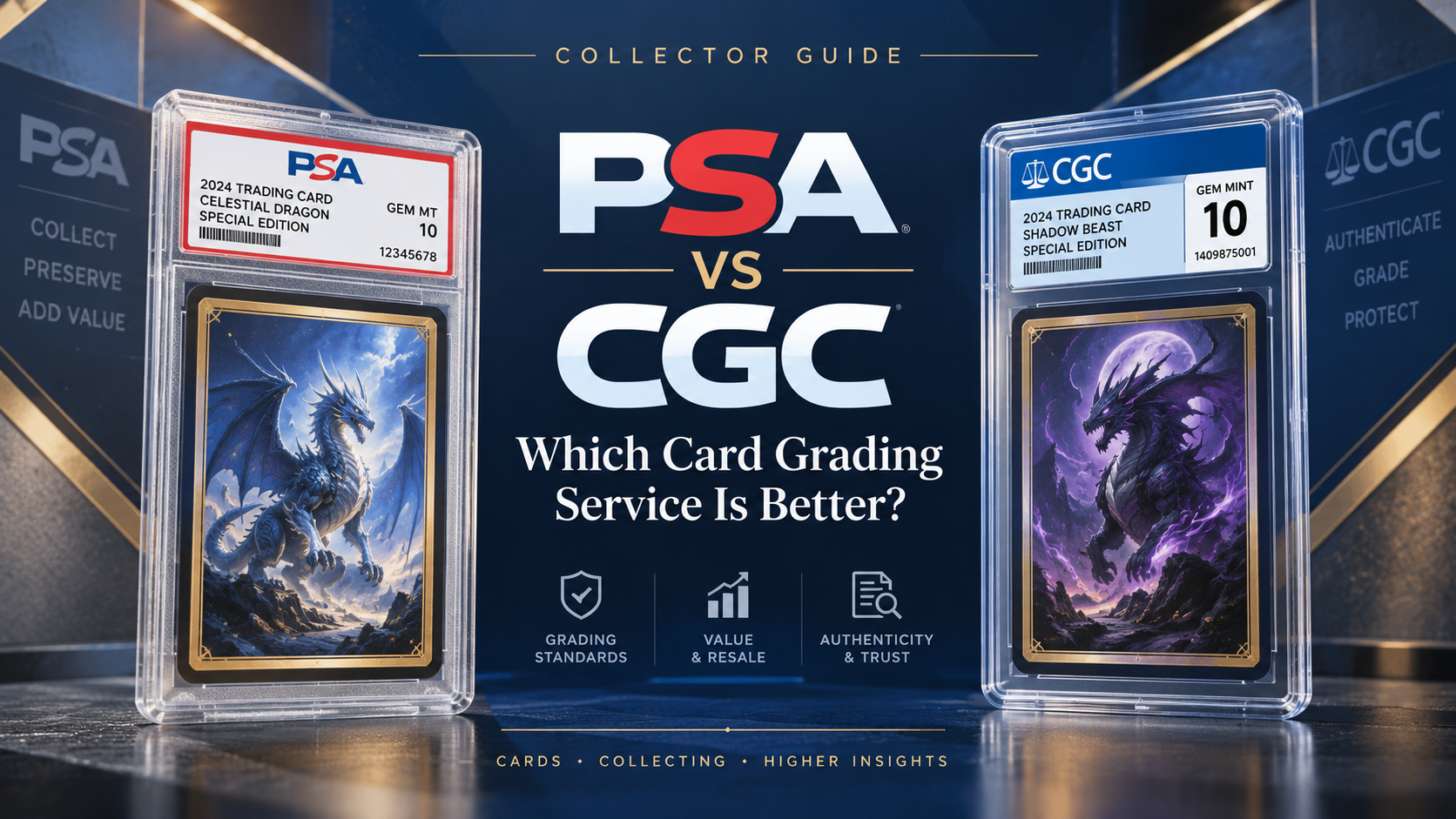
If you're buying or grading trading cards, two names appear again and again: PSA and CGC.
Both authenticate cards. Both assign numerical grades. Both seal cards inside protective holders. And both are widely encountered in Pokémon and other collectible-card markets.
That makes the obvious question:
PSA vs CGC—which one is better?
The problem is that this is usually the wrong first question.
A collector sees a PSA 10 and a CGC 10 and may immediately start comparing the grading companies. But before the logo on the slab matters, four other things should be understood:
The card itself, the exact grade, the market for that card, and what you want from the collection.
That leads to the framework we'll use throughout this guide:
Card → Grade → Market → Slab
In that order.
PSA and CGC both have legitimate roles in card collecting, but their grading systems are not identical. Their top grades mean different things, their slabs appeal to different collectors, and market preferences can change dramatically from one card to another.
This guide explains those differences and, more importantly, gives you a practical way to decide which one makes sense for your specific card.
PSA vs CGC at a Glance
Before getting into the details, here is the basic comparison.
| Factor | PSA | CGC |
|---|---|---|
| Professional card grading | Yes | Yes |
| Numerical grading scale | 1–10 | 1–10 |
| Highest current designation | Gem Mint 10 | Pristine 10 |
| Other current 10-level grade | — | Gem Mint 10 |
| Authentication | Yes | Yes |
| Encapsulation | Yes | Yes |
| Certification lookup | Available | Available |
| Population data | Available | Available |
| Pokémon cards | Widely collected | Widely collected |
| Sports cards | Widely collected | Supported |
| Slab design | PSA system | CGC system |
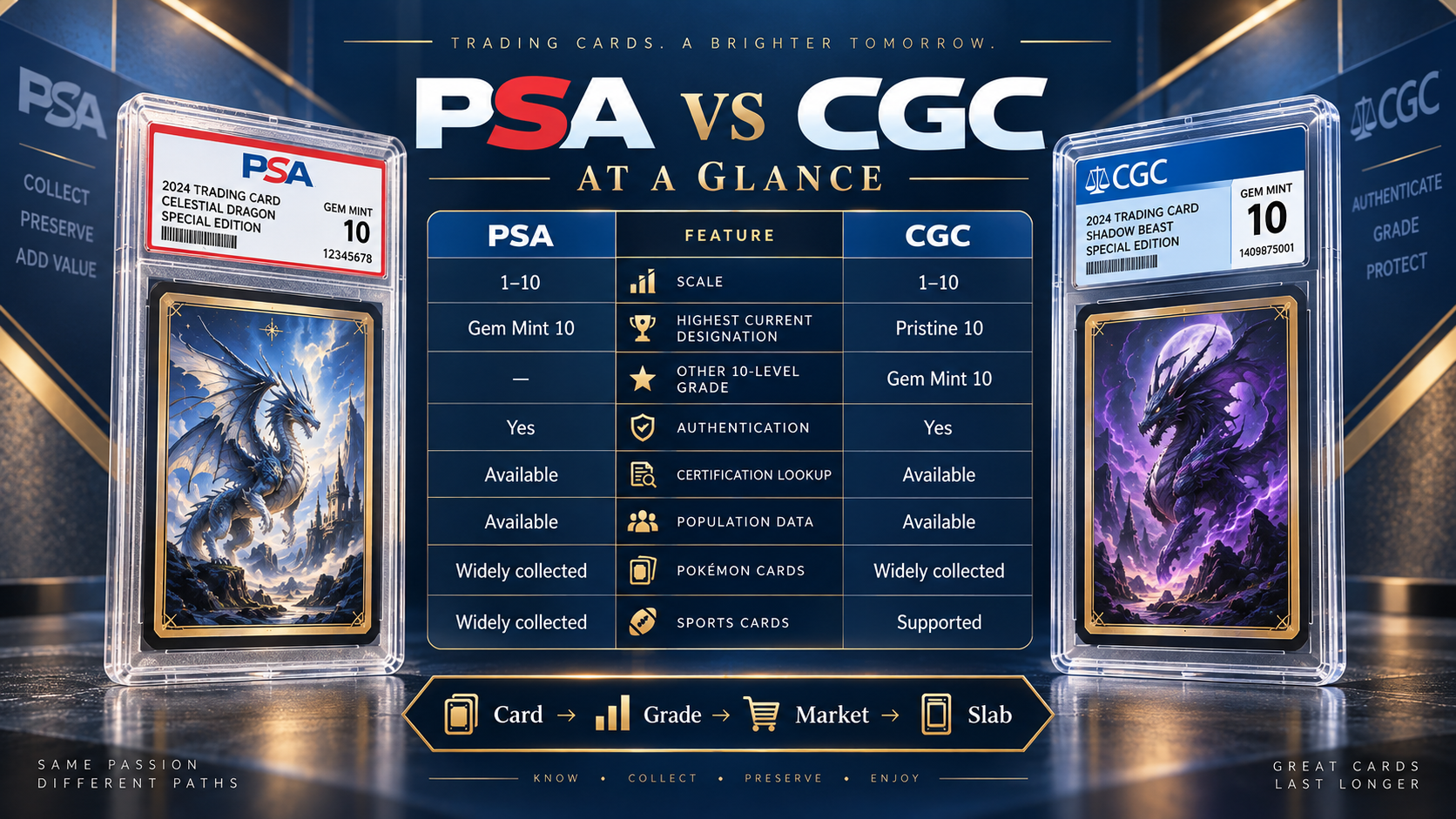
The most important row is near the top.
PSA 10 and CGC 10 are not automatically equivalent grades.
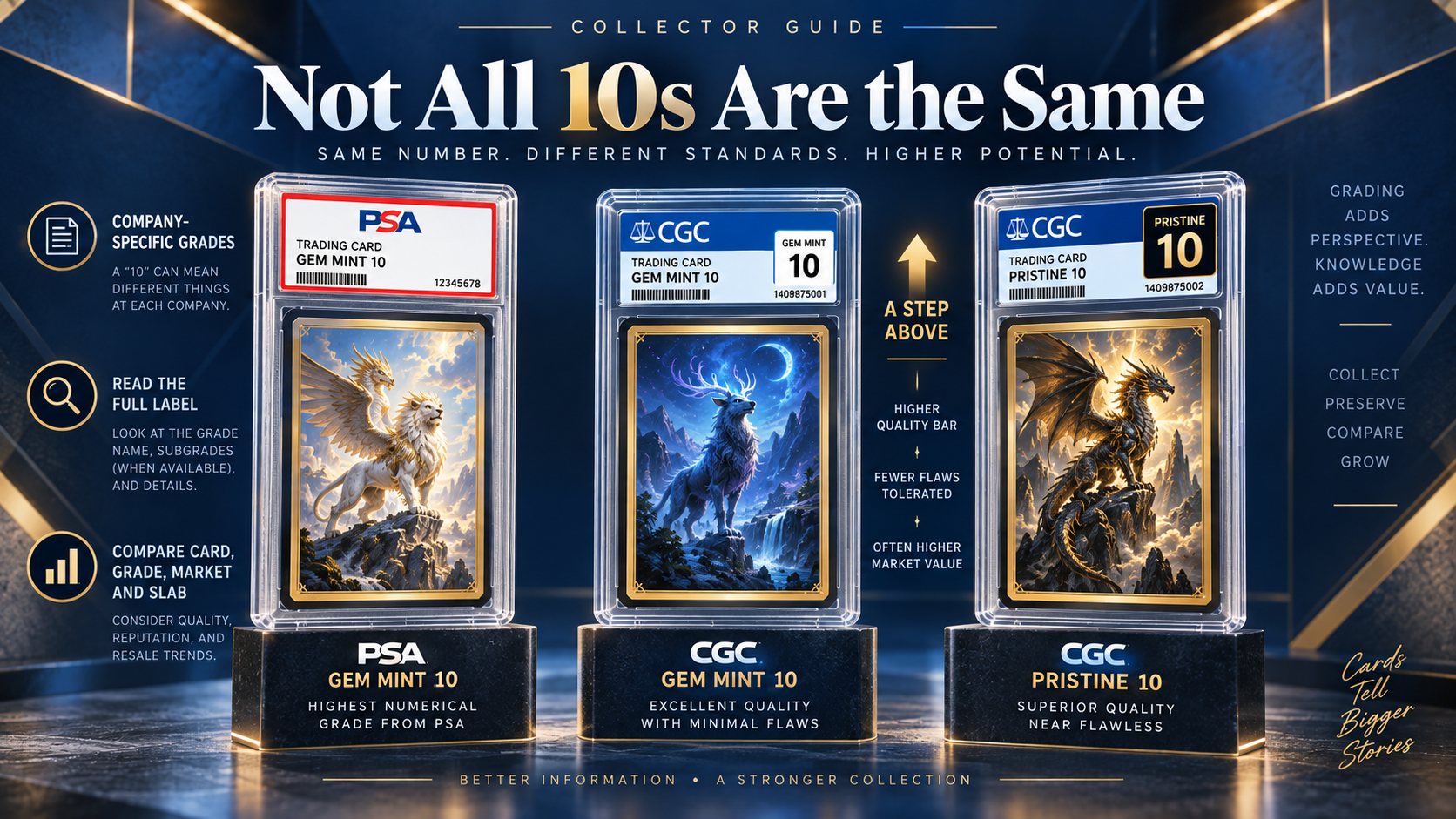
PSA's highest numerical card grade is Gem Mint 10. CGC currently uses both Gem Mint 10 and the higher Pristine 10 designation. CGC describes Pristine 10 as its highest grade and reserves it for cards meeting stricter requirements than its Gem Mint 10 standard.
That distinction alone is enough to show why comparing only the number on the label can be misleading.
What Is PSA?
PSA stands for Professional Sports Authenticator.
For trading cards, PSA provides authentication, condition grading, encapsulation, certification, and population tracking.
Its card grading scale runs from 1 through 10, with PSA 10 Gem Mint representing its highest numerical grade.
PSA's published standards evaluate characteristics such as corners, focus, original gloss, staining and centering. PSA describes a Gem Mint 10 as a virtually perfect card under its grading standard.
If you're still learning how PSA grading itself works, start with:
PSA Graded Pokémon Cards: Grades, Value & Collector Guide
This article focuses instead on what changes when CGC enters the comparison.
What Is CGC Card Grading?
CGC Cards is another professional grading service covering TCGs, sports cards and non-sports cards.
Like PSA, CGC evaluates cards, assigns a numerical condition grade and encapsulates certified cards.
But the top of CGC's current scale works differently.
Collectors can encounter:
- CGC Gem Mint 10
- CGC Pristine 10
CGC states that a Pristine 10 is its highest current grade and is reserved for exceptionally strong cards. A Gem Mint 10 is still a 10 overall, but at least one grading criterion does not meet the requirements of Pristine 10.
That means the phrase:
"CGC 10"
is incomplete information.
You need to know which 10.
Our View: Don't Start With the Grading Company
This is where our approach differs from many PSA vs CGC comparisons.
A lot of articles begin by asking:
Which company has the better reputation?
or:
Which slab sells for more?
Those questions matter—but they should come later.
For an individual collector, we believe a better decision order is:
1. Card
Is this actually a card you want?
2. Grade
What condition did the specific grading company assign?
3. Market
How does that exact card trade in that exact grade?
4. Slab
Which grading company, holder and ecosystem do you prefer?
Why this order?
Because a great card does not become a poor collectible merely because it is in the "wrong" company's slab.
And a mediocre card does not become a great collectible simply because its label says PSA 10.
The slab certifies the collectible. It should not become more important than the collectible itself.
That principle will make almost every comparison in the rest of this article easier.
PSA vs CGC Grading Scales
Both grading companies use a scale that reaches 10.
That's where the similarity can become deceptive.
PSA Grading Scale
At the top of PSA's card scale:
PSA 10 = Gem Mint
Immediately below it:
PSA 9 = Mint
PSA distinguishes the two based on the card's overall condition under its published grading standards.
We go much deeper into that specific comparison here:
PSA 9 vs PSA 10: What's the Difference & Is PSA 10 Worth It?
CGC Grading Scale
CGC's current system has another layer at the top:
CGC Pristine 10
↓
CGC Gem Mint 10
↓
CGC Mint+ 9.5
↓
lower grades
CGC's current published standard describes Pristine 10 as effectively its premium top designation, while Gem Mint 10 allows one grading criterion to fall short of Pristine requirements.
This creates one of the biggest conceptual differences between the two companies:
With PSA, "10" is the top numerical endpoint. With CGC, you still need to ask which kind of 10 you're looking at.
What About Older CGC 9.5 and Perfect 10 Cards?
This is where CGC comparisons become more complicated.
CGC has changed its card grading system over time.
Its official legacy grade key states that older CGC Trading Cards Gem Mint 9.5 slabs correspond to CGC Cards Gem Mint 10 under the current scale.
CGC's online certification tools, Population Report and Registry reflect those legacy Gem Mint 9.5 cards as Gem Mint 10.
Older Perfect 10 cards are different.
Perfect 10 is now a retired grade and retains its Perfect 10 status in CGC's online tools. CGC also states that if a Perfect 10 card is submitted for reholdering, it will receive a Pristine 10 holder—and CGC itself recommends that owners generally not reholder those Perfect 10 cards.
So the simple version is:
| Older CGC Grade | Current Treatment |
|---|---|
| Gem Mint 9.5 | Corresponds to Gem Mint 10 |
| Perfect 10 | Retired legacy grade |
| Perfect 10 reholder | Receives Pristine 10 holder |
This matters when buying older slabs because the label generation can tell you something about when and under which system the card was graded.
CGC 10 vs PSA 10: Are They the Same?
No.
And this is one of the most common mistakes collectors make when comparing slabs online.
A PSA 10 is a grade issued under PSA's standards.
A CGC Gem Mint 10 is issued under CGC's standards.
A CGC Pristine 10 is another CGC designation above Gem Mint 10.
So this comparison:
PSA 10 = CGC 10
is too simplistic.
A better comparison is:
PSA Gem Mint 10 vs CGC Gem Mint 10 vs CGC Pristine 10
Even then, there is no universal conversion table.
You cannot reliably say:
"A CGC Pristine 10 is always worth X% more."
or:
"A CGC Gem Mint 10 would definitely cross to PSA 10."
Different companies grade according to their own standards.
Why Collectors Still Compare PSA 10 and CGC 10
Because the cards compete in the same market.
Imagine you want one specific Pikachu card.
You find:
- PSA 10
- CGC Gem Mint 10
- CGC Pristine 10
The cards may all look excellent.
Now your decision is no longer simply about condition.
You're comparing:
- Price
- Population
- Eye appeal
- Slab design
- Grading-company preference
- Future collection consistency
- Market liquidity
This is why we think grade comparison is only one layer of the decision.
The slab label tells you how a company graded the card.
It does not tell you which copy you should personally buy.
PSA vs CGC Slabs: Does the Holder Matter?
Yes—but often for a different reason than people expect.
The slab matters because you're going to live with it.
Label and Holder Design
PSA and CGC cards have noticeably different visual identities.
One collector may prefer PSA's familiar presentation.
Another may prefer the appearance of a CGC holder.
Neither preference is objectively correct.
Collection Consistency
This becomes more important as your collection grows.
Suppose you own 25 PSA Pikachu cards.
Card number 26 appears at a great price in a CGC slab.
From a pure value standpoint, the CGC copy may make sense.
But visually:
PSA
PSA
PSA
PSA
CGC
PSA
may bother you.
Another collector won't care at all.
That's why slab consistency is not a trivial issue—it's simply a personal collecting variable, not a universal measure of quality.
The "Slab Premium" Trap
There is a useful trap to avoid here.
Sometimes a collector stops asking:
Do I like this card?
and starts asking only:
Is it in the right slab?
At that point, the holder has begun controlling the collection.
Our view is that slab consistency is valuable after you've established that you want the card.
It should rarely override the card completely.
PSA vs CGC for Pokémon Cards
For Pokémon collectors, PSA vs CGC is particularly interesting because both slab types are common enough that buyers often have genuine choices.
But "Pokémon cards" is still far too broad to produce one winner.
A modern Pikachu, vintage Charizard, Japanese promo and low-demand regular card should not all be treated the same.
Start With the Exact Pokémon Card
Before comparing PSA and CGC, identify:
- Pokémon
- Year
- Set
- Card number
- Language
- Promo status
- Variant
- Grade
Then look at the market for that exact card.
This prevents a common mistake:
comparing grading companies when the real price difference is being caused by the card or variant.
When PSA May Make More Sense for a Pokémon Collector
PSA may be attractive if:
- Your existing collection is mostly PSA
- The card has a deeper PSA sales history
- You prefer PSA's slab
- Comparable PSA copies are easier to buy and sell
- You specifically collect PSA grades
Notice that none of these says:
PSA is always better for Pokémon.
They are situational advantages.
When CGC May Make More Sense for a Pokémon Collector
CGC can be attractive when:
- You prefer the CGC holder
- A CGC copy offers better value
- You already build a CGC collection
- You're specifically interested in Pristine 10 cards
- The specific slab has stronger eye appeal
- You don't care about keeping every card under one grading company
For a personal collection, a beautiful CGC copy at a compelling price may be a better purchase than paying a large premium simply to obtain a PSA label.
Our Pokémon Rule: Don't Pay for a Logo You Don't Care About
This is one of the strongest opinions we have in this comparison.
If two copies of a card both satisfy your condition expectations and you genuinely do not care which slab is on your shelf, paying a large premium solely because one says PSA may not improve your collection.
That doesn't mean the market premium is irrational.
Liquidity and collector preference can justify real differences.
But there is a distinction between:
market value
and
personal collecting value
Understanding which one matters to you prevents a lot of unnecessary spending.
PSA vs CGC for Sports Cards
Sports cards add another dimension because the exact player, rookie status, set and parallel can matter enormously.
For an NFL card, collectors may consider:
- Player
- Rookie status
- Set
- Base vs parallel
- Serial numbering
- Autograph
- Grade
- Grading company
Consider two hypothetical cards:
Card A: mass-produced base rookie, PSA 10
Card B: scarce numbered rookie parallel, CGC 9
The PSA 10 label does not automatically make Card A the stronger collectible.
The scarcity and desirability of Card B could matter far more.
That's another example of why our order remains:
Card → Grade → Market → Slab
rather than:
Slab → Grade → Card
Which Has Better Resale Value: PSA or CGC?
This is one of the questions most collectors eventually ask.
It is also one of the areas where overly simple advice becomes dangerous.
You may hear:
PSA always sells for more.
That is not a reliable universal rule.
Markets are card-specific.
The difference can depend on:
- Card
- Grade
- Category
- Population
- Collector base
- Availability
- Recent transactions
- Market conditions
The correct comparison is not:
PSA sales vs CGC sales in general.
It is:
the exact same card, in comparable grades, over a meaningful sample of recent completed sales.
Asking Price Is Not Market Value
This deserves special emphasis.
Seeing:
PSA 10 — listed at $1,500
CGC 10 — listed at $900
doesn't prove the PSA copy is worth $600 more.
Those are asking prices.
Neither may actually sell.
When market value matters, completed transactions are much more informative than optimistic seller listings.
Liquidity Matters Too
Price isn't the only consideration.
Suppose one slab generally sells for $1,000 and another for $950.
If the first receives many more bids and sells much more frequently, some collectors may value that liquidity.
This is especially relevant for collectors who expect to rotate cards rather than hold everything permanently.
So "better resale" can mean two things:
- higher selling price;
- easier/faster selling.
Those are not always the same.
PSA vs CGC Population Reports
Population reports are useful—but frequently misused.
They tell you how many cards a grading company has recorded at different grades.
They do not tell you the total number of surviving copies of a card.
And they do not tell you how many people want one.
CGC itself cautions collectors against treating population numbers alone as proof of rarity or value.
A Low Population Isn't Automatically Bullish
Imagine:
Card A
20 graded copies.
Card B
10,000 graded copies.
It is tempting to say Card A is "rarer and therefore better."
But what if only 10 people care about Card A while 100,000 collectors want Card B?
Population without demand is incomplete information.
Our preferred equation is:
Grade scarcity × collector demand
rather than:
low population = valuable
Don't Directly Compare PSA and CGC Populations
Imagine:
- PSA population: 15,000
- CGC population: 1,500
That doesn't automatically mean CGC slabs are ten times scarcer.
It may simply mean collectors submitted more copies to PSA.
Population is often most useful within the same grading ecosystem:
PSA 10 vs PSA 9 population
or:
CGC Pristine 10 vs CGC Gem Mint 10 population
Those comparisons help explain condition scarcity.
PSA vs CGC Pricing and Turnaround Times
If you're submitting cards rather than buying already-graded slabs, grading cost and turnaround matter.
But this is one section where we deliberately do not recommend relying on static price tables.
Fees and service conditions change.
Grading companies can adjust:
- service tiers
- prices
- declared-value limits
- bulk submissions
- estimated turnaround
- promotions
- membership benefits
The right approach is to compare current official pricing when you're actually ready to submit.
When calculating the real cost, include:
- grading fee
- shipping
- insurance
- card quantity
- declared value
- service tier
- expected turnaround
A service that appears cheaper per card may not remain cheaper after the full submission cost is included.
Which Is Better for Grading Your Own Cards?
Choosing a grading company for a raw card is different from choosing between two already-graded slabs.
Before submitting, ask five questions.
1. What Are You Grading?
Don't start with the company.
Start with the card.
A modern Pokémon card, vintage TCG card and NFL rookie parallel can have very different grading markets.
2. Why Are You Grading It?
Is your goal:
- Authentication?
- Protection?
- Display?
- Condition certification?
- Resale?
- Set consistency?
Someone grading for personal display may make a different decision from someone grading primarily for resale.
3. What Grade Do You Realistically Expect?
One of the biggest mistakes new submitters make is calculating everything around a 10.
A clean raw card can still have:
- centering issues
- surface marks
- edge wear
- corner imperfections
If the economics only work when the card receives the highest grade, the submission may be riskier than it looks.
4. What Does the Exact Card's Market Prefer?
Look at real examples.
Search the same card in:
- PSA
- CGC
Compare:
- grades
- completed sales
- number of listings
- population
- buyer activity
This is more useful than asking which company is "better overall."
5. Which Slab Would You Actually Want to Keep?
This matters particularly for personal collections.
If you strongly prefer one slab design, that preference is legitimate.
You're collecting the item—not building a spreadsheet for someone else.
Which Is Better When Buying Already-Graded Cards?
When the card is already graded, the decision becomes simpler.
The grading fee and submission risk are gone.
Now evaluate six things.
1. The Card
Would you still want it if you couldn't see the grading-company logo?
If the answer is no, think carefully.
2. The Grade
Understand what that company's grade means.
3. The Eye Appeal
Two slabs with the same numerical grade do not necessarily look identical.
4. The Price
Compare completed transactions where possible.
5. The Population
Use population as context—not a value guarantee.
6. Your Collection
Does slab consistency matter to you?
Our Four-Step Buying Test
For an already-graded card, we recommend this quick test:
Step 1 — Would I buy the card raw?
If not, a slab probably shouldn't change your mind.
Step 2 — Would I be happy with this condition?
Ignore the label for a moment and look at the card.
Step 3 — Does the price make sense for this exact slab?
Compare the actual market.
Step 4 — Does the grading company matter to me?
Only now does PSA vs CGC become the final decision.
This is the core idea of the entire article:
The grading company should usually be the final filter, not the first filter.
PSA or CGC: Which Should You Choose?
There is no universal winner.
But there are situations where one may fit better.
PSA May Make More Sense If:
- Your existing collection is primarily PSA
- You prefer PSA slabs
- The specific card has strong PSA market activity
- Liquidity matters to you
- You are intentionally building a PSA-graded set
CGC May Make More Sense If:
- You prefer CGC slabs
- You're building a CGC collection
- A CGC copy offers better card-for-money value
- You specifically want Pristine 10 examples
- The exact CGC slab has better eye appeal
Either May Make Sense If:
- You're collecting primarily for enjoyment
- Both cards meet your condition standards
- Slab consistency doesn't matter
- You understand the grades
- The card matters more than the grading-company logo
PSA vs CGC by Collector Type
| Collector Type | Our Starting Point |
|---|---|
| Pokémon beginner | Card first, grader second |
| Existing PSA collector | PSA often improves consistency |
| Existing CGC collector | CGC often improves consistency |
| Budget collector | Compare the best card/grade for the price |
| Display collector | Eye appeal + slab preference |
| Resale-focused collector | Compare actual market liquidity |
| Sports card collector | Evaluate the exact player/card market |
| Rare-card collector | Rarity and demand before grader |
| High-grade collector | Understand each company's top grades |
This is deliberately not a table that says:
beginner = PSA
serious collector = PSA
everyone else = CGC
Real collecting decisions are more nuanced than that.
Explore Professionally Graded Pokémon Cards
For collectors who enjoy discovering graded cards through a mystery-box-style format, the HapaBox PSA GRADED CARD box can include professionally graded Pokémon cards across different characters, grades and grading companies.
That makes it particularly relevant to this discussion: instead of seeing only one slab ecosystem, collectors may encounter different grading labels and grades within the same collectible format.
Because box inventories and prize pools can change, always review the current contents before participating.
Explore the HapaBox PSA Graded Card Box
FAQ About PSA vs CGC
Is PSA better than CGC?
Not universally.
The better choice depends on the exact card, grade, price, collector market, slab preference and your goals.
For many collectors, asking "Which exact copy should I buy?" produces a better decision than asking "Which company is always better?"
Is CGC 10 the same as PSA 10?
No.
PSA's top numerical card grade is Gem Mint 10.
CGC currently distinguishes between Gem Mint 10 and the higher Pristine 10 designation.
Because PSA and CGC use their own grading systems, their 10 grades should not automatically be treated as equivalent.
Is PSA or CGC better for Pokémon cards?
Both can make sense.
For Pokémon cards, compare the exact card, grade, price, population, eye appeal and market first.
If you're building a uniform slab collection, grading-company consistency can then become an important deciding factor.
Does PSA always sell for more than CGC?
No universal rule guarantees that.
Some cards and market segments may favor PSA, while other cards may behave differently.
For resale decisions, compare recent completed sales of the exact card in comparable grades rather than relying on a blanket rule.
Is CGC grading respected?
CGC is an established professional grading service covering TCG, sports and non-sports cards and publishes its own grading standards and certification system.
Collector preference for one grading company over another is a separate issue from whether the grading service itself is legitimate.
Does CGC still use 9.5?
CGC's current standard scale still includes Mint+ 9.5, but the older Gem Mint 9.5 designation from CGC Trading Cards corresponds to Gem Mint 10 under the current system.
Those older Gem Mint 9.5 cards are reflected as Gem Mint 10 in CGC's online tools.
What happened to CGC Perfect 10?
Perfect 10 is a retired CGC legacy grade and is no longer newly assigned.
Existing Perfect 10 cards retain that status in CGC's online tools. CGC states that Perfect 10 cards submitted for reholdering will receive a Pristine 10 holder, although CGC recommends owners generally keep the original Perfect 10 holder.
Should I grade my cards with PSA or CGC?
First determine:
- what you're grading,
- why you're grading it,
- what grade you realistically expect,
- how comparable graded copies perform,
- which slab you prefer.
Then compare current submission costs and service options.
The correct answer may differ from card to card.
Final Thoughts
PSA vs CGC sounds like a battle between two grading companies.
For collectors, we think that's the wrong way to frame it.
The real decision is usually:
Which specific graded card gives me the best combination of collectible quality, grade, price and ownership experience?
PSA and CGC are tools for describing and protecting collectibles.
They are not the collectibles themselves.
Remember the framework:
Card → Grade → Market → Slab
Choose the card first.
Understand what the grade actually means.
Look at the market for that exact card and grade.
Only then decide how much the grading company matters to you.
That approach avoids two common mistakes: overpaying for a label you don't actually care about and overlooking a great card simply because it sits in a different slab.
Continue Learning
If you're still learning how PSA grading works:
PSA Graded Pokémon Cards: Grades, Value & Collector Guide
If you're deciding between PSA 9 and PSA 10:
PSA 9 vs PSA 10: What's the Difference & Is PSA 10 Worth It?
Want to Explore Graded Pokémon Cards?
If you enjoy a mystery-box-style collecting experience, review the current HapaBox graded Pokémon card prize pool before deciding whether it fits your collecting style.