PSA 9 vs PSA 10: What's the Difference and Is PSA 10 Worth It?
A practical PSA 9 vs PSA 10 comparison covering condition, value, collector appeal, and when paying more for a PSA 10 actually makes sense.

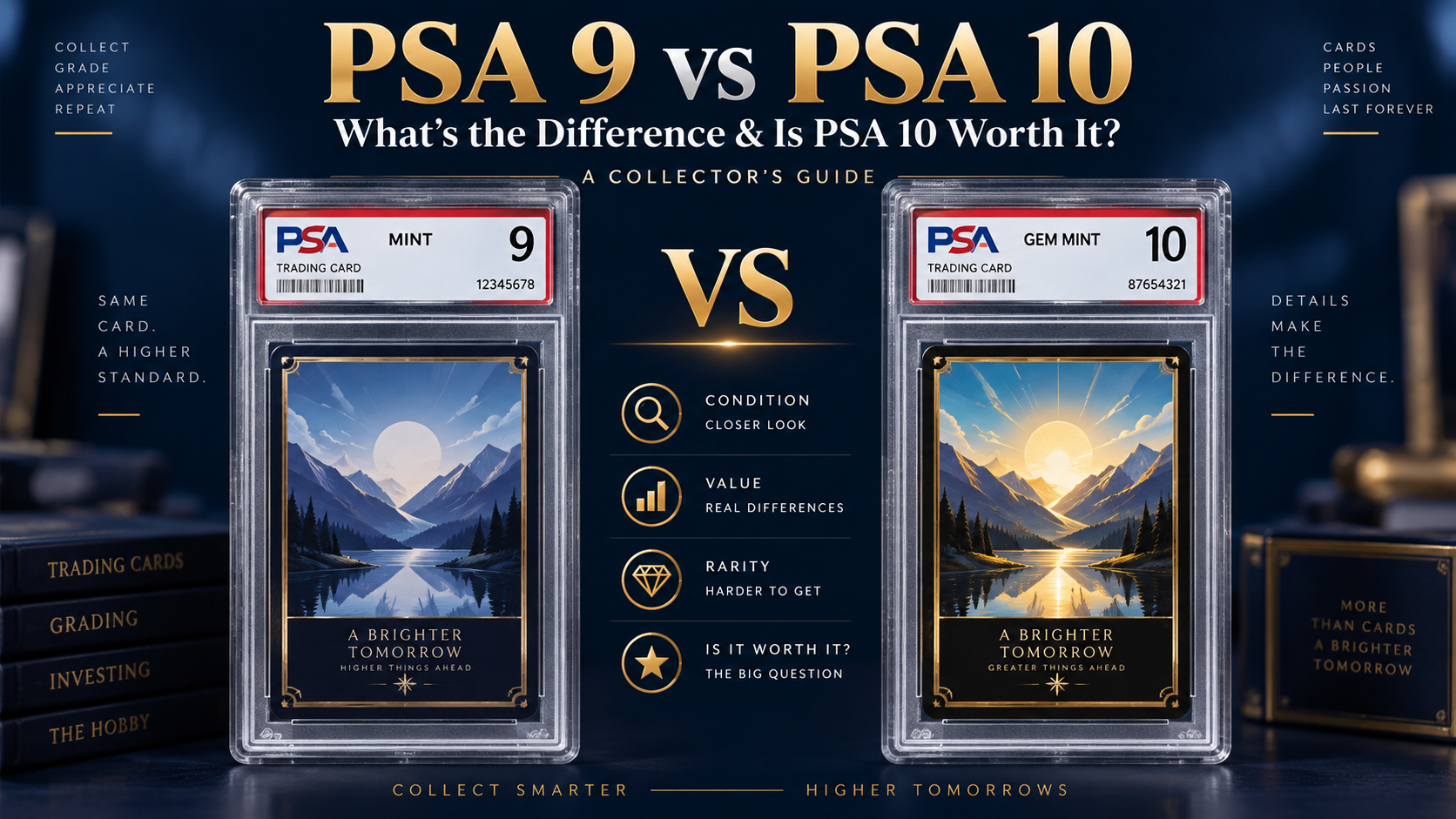
Two copies of the same trading card can look almost identical, yet one may receive a PSA 9 while the other earns a PSA 10.
For collectors, that single-point difference can sometimes lead to a surprisingly large price gap.
So what actually separates PSA 9 from PSA 10?
And more importantly:
Is paying extra for PSA 10 really worth it?
The short answer is that PSA 10 is the higher grade, but that does not automatically make it the better purchase for every collector.
A PSA 9 can often provide nearly the same visual appeal at a lower price, while a PSA 10 may make more sense when condition rarity, population, or collecting goals justify the premium.
This guide breaks down the differences between PSA 9 and PSA 10, how those differences can affect value, and how to decide which grade fits your collection.
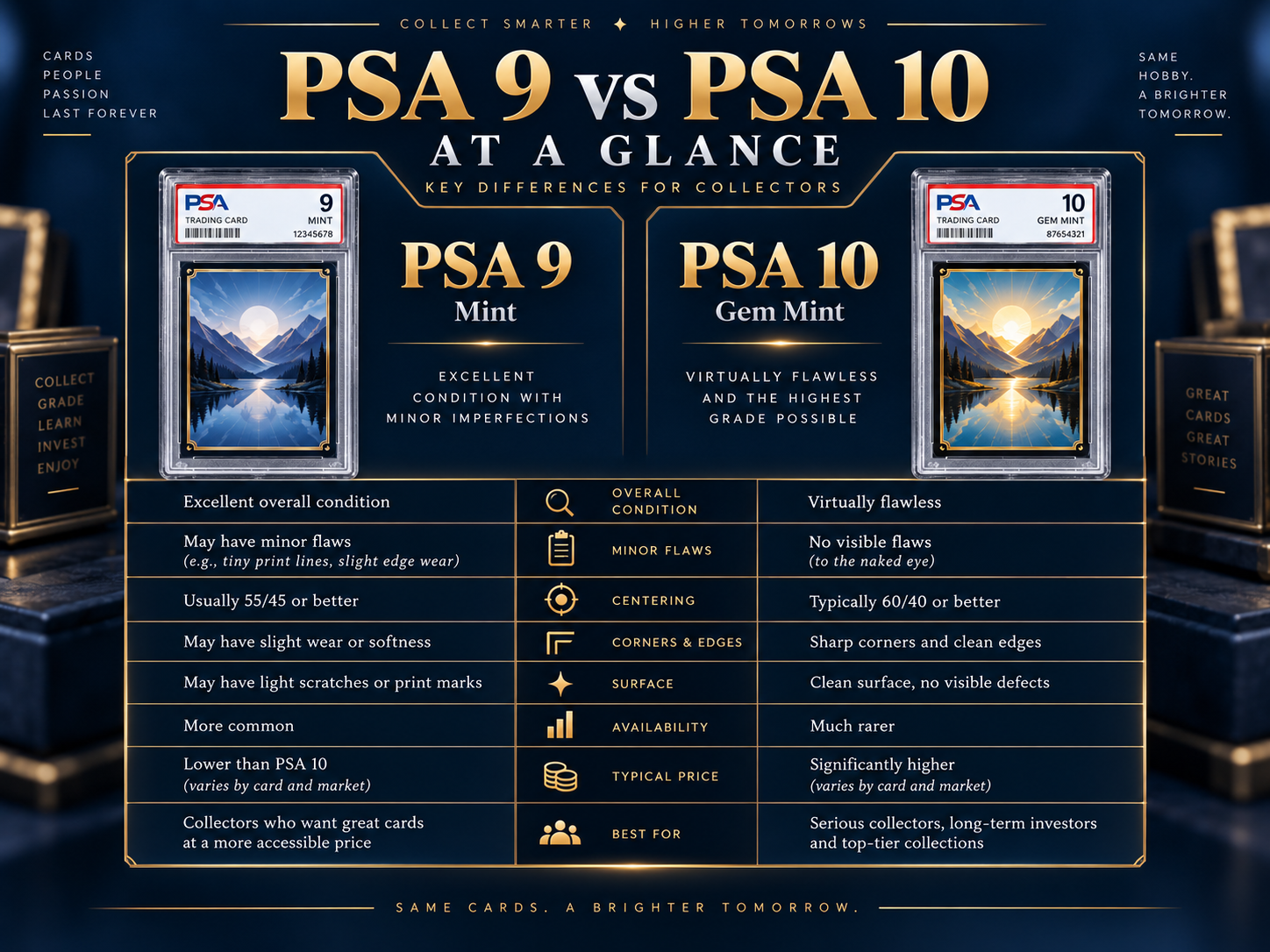
PSA 9 vs PSA 10 at a Glance
Here is the simplest way to compare the two grades.
| Factor | PSA 9 | PSA 10 |
|---|---|---|
| Grade name | Mint | Gem Mint |
| Overall condition | Excellent | Virtually perfect |
| Minor flaws | May be present | Very limited |
| Centering | Strong, but may show minor imbalance | Typically stronger overall |
| Corners and edges | Usually very clean | Expected to be exceptionally clean |
| Surface | Minor flaw may be present | Very high-quality surface |
| Availability | Often more common | Often less common |
| Typical price | Usually lower | Often carries a premium |
| Best suited for | Value-focused collectors | Grade-focused collectors |
The most important thing to remember is:
PSA 10 is the higher grade, but PSA 9 is still a high-quality collectible grade.
A PSA 9 should not automatically be viewed as a disappointing result.
For many cards, it can actually be the more practical purchase.
What Is a PSA 9?
A PSA 9 is classified as Mint.
That means the card is in excellent overall condition but may have a minor imperfection that prevents it from reaching the highest numerical grade.
Those imperfections may involve:
- Slight centering issues
- Minor corner wear
- Small edge imperfections
- Subtle surface flaws
- Minor printing imperfections
In many cases, these differences are difficult to notice without close inspection.
A PSA 9 can still look exceptionally clean when viewed inside its slab.
This matters for collectors who are buying cards primarily for display rather than chasing the highest possible grade.
If a PSA 9 and PSA 10 version of the same card look almost identical from normal viewing distance, some collectors would rather buy the PSA 9 and use the savings to add another card to their collection.
That makes PSA 9 especially attractive for collectors who care about both quality and value.
What Is a PSA 10?
A PSA 10 is classified as Gem Mint.
It is the highest numerical grade PSA assigns to trading cards and represents a card with exceptionally strong overall condition.
Collectors generally expect a PSA 10 card to show:
- Sharp corners
- Clean edges
- Strong centering
- High-quality surface
- Strong overall eye appeal
However, PSA 10 should not be interpreted as meaning a card is literally flawless under every possible form of magnification.
Grading evaluates the overall card against PSA's standards, and minor manufacturing characteristics may still exist.
What PSA 10 tells the collector is that the submitted card met the requirements for PSA's top numerical grade.
If you're new to grading in general, our PSA Graded Pokémon Cards: A Complete Guide for Collectors explains how grading, slabs, authentication, rarity, and card value work together.
What Actually Separates PSA 9 From PSA 10?
For many cards, the difference can be surprisingly subtle.
The distinction usually comes down to several condition factors.
Centering
Centering describes how evenly the printed image sits within the borders of the card.
A card may look extremely clean overall but still receive PSA 9 if its centering is not strong enough for Gem Mint consideration.
Modern cards can come straight from packs with imperfect centering.
That means:
Pack fresh does not automatically mean PSA 10.
This is one of the most common misconceptions among new collectors.
Corners
Corners matter because even very minor wear can affect a card's overall condition.
A PSA 9 may have extremely small corner imperfections that are difficult to see in normal photographs.
A PSA 10 is expected to present stronger overall corner quality.
This can become especially important with older cards, where finding examples with four consistently strong corners becomes increasingly difficult.
Edges
Collectors often inspect card edges for:
- Whitening
- Chipping
- Wear
- Small manufacturing imperfections
Even a small amount of edge whitening may affect the final grade.
Cards with darker borders can make these problems particularly easy to notice.
Surface
Surface flaws can be some of the hardest issues to identify.
They may include:
- Fine scratches
- Print lines
- Small stains
- Indentations
- Surface marks
- Manufacturing defects
A card that appears perfect in normal lighting may reveal a subtle issue when examined more carefully.
This is one reason predicting whether a raw card will receive PSA 9 or PSA 10 can be difficult.
Can You Tell a PSA 9 From a PSA 10 Just by Looking at It?
Sometimes.
But not always.
There are PSA 9 cards where the reason for the grade is relatively easy to identify.
You might notice slightly uneven centering or a small amount of edge whitening.
Other times, a PSA 9 can look nearly identical to a PSA 10 under normal viewing conditions.
The flaw may be:
- Extremely small
- Located on the back
- Visible only under certain lighting
- Related to surface quality
- Difficult to identify through a slab
This creates an important opportunity for collectors.
If visual appeal matters more to you than owning the highest possible grade, a strong-looking PSA 9 can sometimes offer excellent value.
You may get almost the same display experience without paying the Gem Mint premium.
Why Can PSA 10 Cost So Much More Than PSA 9?
PSA 10 can attract a significant premium for several reasons.
It Is PSA's Highest Numerical Grade
Many collectors simply prefer owning the highest grade available.
For someone building a high-grade collection, PSA 10 becomes the natural target.
That alone can create additional demand.
PSA 10 Can Be Harder to Find
For some cards, many copies may receive PSA 9 while comparatively fewer receive PSA 10.
When Gem Mint examples are meaningfully scarcer, collectors competing for those copies can push prices higher.
But this is not true for every card.
Some modern cards have very large PSA 10 populations.
That is why population data should always be considered alongside actual collector demand.
Collectors Like Consistency
Some collectors build collections around a specific grade.
For example, someone might want:
- Every card in PSA 10
- Every Pikachu promo in PSA 10
- Every rookie card from a particular set in PSA 10
Once a collector has chosen that standard, replacing PSA 10 with PSA 9 may not fit the collection.
The Number 10 Has Psychological Appeal
There is also a simple psychological factor.
Collectors immediately understand:
10 = top grade
That makes PSA 10 easy to recognize and compare.
The actual visual difference between PSA 9 and PSA 10 may sometimes be small, but the difference on the label is obvious.
That can create a premium that is larger than the visible condition difference might suggest.
How Much More Is a PSA 10 Worth Than a PSA 9?
There is no universal answer.
Be cautious whenever someone claims something like:
PSA 10 is always worth twice as much as PSA 9.
Collectible markets do not work that way.
The difference depends on the exact card.
Important factors include:
- Card rarity
- PSA population
- Pokémon or player popularity
- Set popularity
- Age
- Language
- Promotional status
- Collector demand
- Recent comparable sales
Consider two simplified examples.
Example A: Significant Grade Scarcity
Imagine a desirable card where many copies have received PSA 9 but relatively few have received PSA 10.
Collectors specifically chasing Gem Mint examples are competing for a smaller supply.
That can create a substantial PSA 10 premium.
Example B: Large PSA 10 Population
Now imagine a modern card with thousands of PSA 10 copies available.
If Gem Mint examples are easy to find, the premium over PSA 9 may be considerably smaller.
The lesson is simple:
Never judge a PSA 10 premium without looking at the exact card.
PSA 9 vs PSA 10 for Pokémon Cards
Pokémon cards are a good example of why the grade premium can vary dramatically.
For highly desirable cards—such as certain Pikachu, Charizard, Japanese promo, vintage, or modern chase cards—collectors may place strong value on Gem Mint examples.
But even cards featuring the same Pokémon can behave very differently.
A PSA 10 Pikachu promotional card with limited availability may have a completely different market from a modern Pikachu card produced in large quantities.
This is why the card should always come first.
If you're collecting Pokémon cards, consider:
- How desirable is the card itself?
- How scarce is the release?
- How many PSA 10 copies exist?
- How large is the price difference from PSA 9?
- Can you actually see a meaningful condition difference?
- Is Gem Mint important to your collection?
For many collectors, PSA 9 can be particularly attractive for expensive Pokémon cards.
It allows them to own a Mint example without always paying the substantial premium attached to PSA 10.
We will explore this further in our upcoming guides to rare Pikachu cards and Pikachu PSA 10 cards.
PSA 9 vs PSA 10 for Football Cards
The same logic applies to sports cards.
NFL collectors often evaluate cards based on factors such as:
- Rookie status
- Player popularity
- Set
- Parallel
- Serial numbering
- Autograph
- Grade
A PSA 10 rookie card may attract a strong premium if Gem Mint copies are difficult to obtain.
But grading is only part of the picture.
A scarce numbered rookie card in PSA 9 may still be far more collectible than a mass-produced base card in PSA 10.
For sets such as Panini Prizm and Donruss Optic, collectors often pay close attention to both the card variant and the grade.
The correct order remains:
Card first. Grade second.
Is a PSA 9 Better Value for Collectors?
Very often, it can be.
That does not mean PSA 9 is always the better choice.
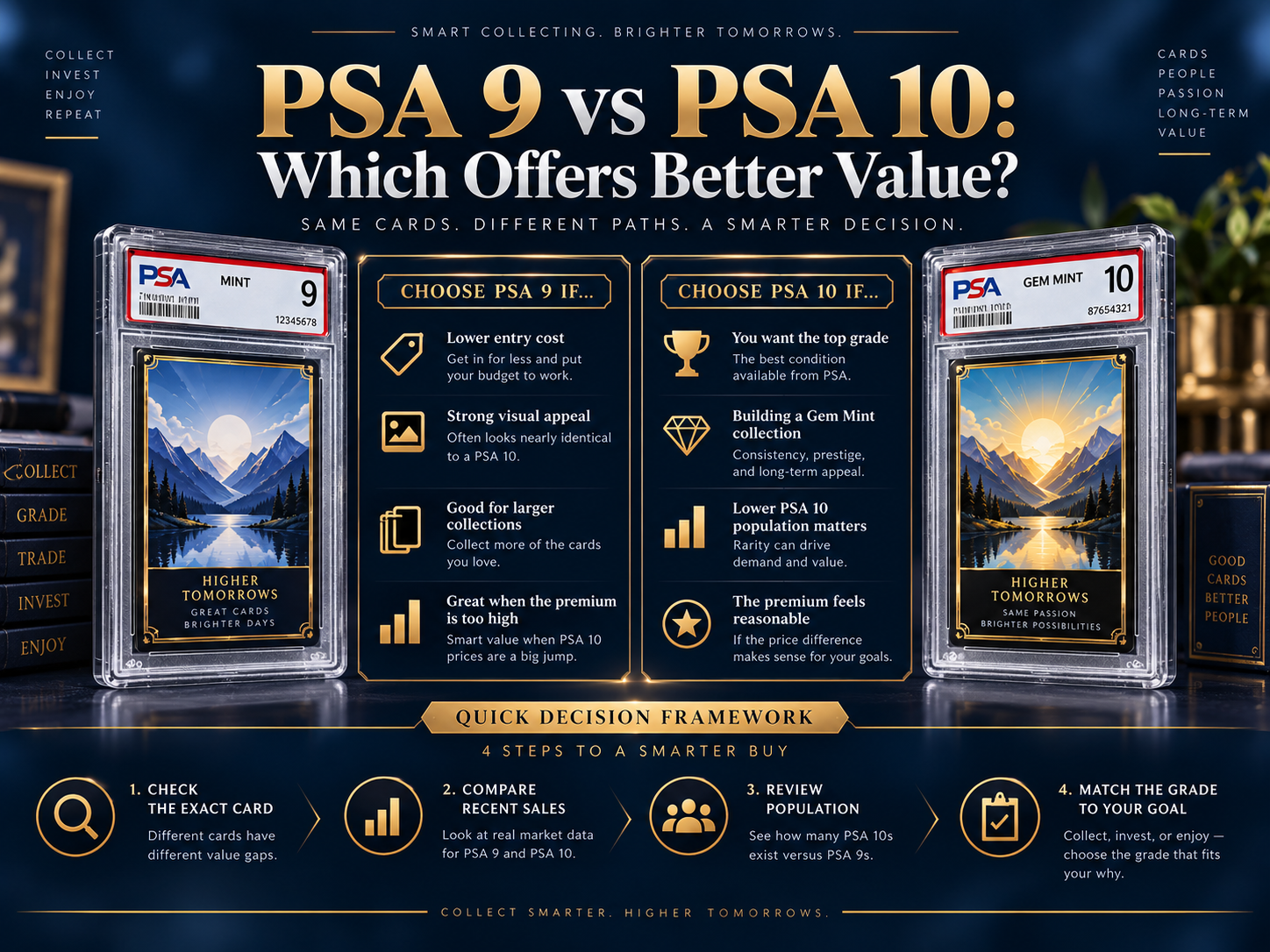
It means PSA 9 frequently offers an attractive balance between high condition and price.
PSA 9 May Make More Sense If:
- You care more about the card than the label
- PSA 10 carries a very large premium
- The visual difference is minimal
- You collect many different cards
- You have a fixed collecting budget
- You want older cards in strong condition
Imagine your budget allows you to buy either:
one PSA 10 card
or
two or three PSA 9 cards you also want
Depending on your collecting goals, the second option may produce a collection you enjoy more.
When Does PSA 10 Make More Sense?
PSA 10 can be the better choice when the grade itself matters to you.
PSA 10 May Make More Sense If:
- You specifically collect Gem Mint cards
- You are building a PSA 10 set
- PSA 10 population is meaningfully lower
- The premium is reasonable for you
- You strongly value top-grade condition
- The card is particularly important to your collection
Some collectors would rather own one exceptional Gem Mint example than several lower-grade cards.
There is nothing wrong with that approach.
The important thing is understanding what you are paying for.
When Is Paying More for PSA 10 Worth It?
Instead of asking whether PSA 10 is always worth the premium, use a simple decision process.
1. Identify the Exact Card
Make sure you know the:
- Year
- Set
- Card number
- Language
- Variant
- Parallel
- Grade
Small differences can completely change the market.
2. Compare Recent PSA 9 and PSA 10 Sales
Do not rely on asking prices alone.
When possible, compare completed sales of the exact same card in both grades.
That gives you a better idea of the real market premium.
3. Check the PSA Population
Compare how many examples exist in PSA 9 and PSA 10.
If PSA 10 is significantly harder to obtain, the premium may be easier to understand.
If PSA 10 copies are extremely common, think carefully before paying a large premium.
4. Evaluate the Visual Difference
Look closely at high-quality photographs.
Ask yourself:
Can I actually see enough difference to care?
For some collectors, the answer will be yes.
For others, a clean PSA 9 may look practically identical on display.
5. Think About Your Collecting Goal
Are you building:
- A display collection?
- A complete set?
- A character collection?
- A high-grade collection?
- A rookie-card collection?
- A personal favorites collection?
Your answer can change which grade makes the most sense.
When PSA 9 May Be the Smarter Choice
PSA 9 becomes especially interesting when PSA 10 prices rise much faster than the visible difference in condition.
That is why many experienced collectors actively look for strong PSA 9 examples.
Expensive Cards
If the PSA 10 premium is extremely large, PSA 9 can make an otherwise difficult card much more accessible.
Vintage Cards
With older cards, Mint condition can already represent exceptional preservation.
A PSA 9 vintage card can be an outstanding collectible.
Large Collections
Collectors building dozens or hundreds of graded cards may prefer PSA 9 because their budget goes further.
Display Collections
If the card looks excellent inside the slab, the label difference may matter less when the goal is simply enjoying the artwork.
Does PSA 10 Mean a Card Is Rare?
No.
This is a critical distinction.
PSA 10 means that that specific copy received PSA's Gem Mint grade.
It does not mean the underlying card itself is rare.
These are three separate concepts:
Card Rarity
How scarce is the actual card or release?
Grade
What condition did PSA assign to this particular copy?
Grade Population
How many copies have PSA graded at that level?
A widely produced card can have thousands of PSA 10 copies.
A genuinely rare card might have very few graded examples at any grade.
That is why PSA 10 should never be used as a substitute for understanding card rarity.
PSA 9 or PSA 10: Which Should You Buy?
There is no single correct answer, but this framework can help.
| Collector Type | Good Starting Point |
|---|---|
| Budget-focused collector | PSA 9 |
| Display collector | PSA 9 or PSA 10 |
| Gem Mint collector | PSA 10 |
| Large set builder | Often PSA 9 |
| Beginner | Often PSA 9 |
| High-grade specialist | PSA 10 |
| Rare-card collector | Card rarity first, grade second |
A beginner should not feel pressured to buy PSA 10 simply because it has the highest number on the label.
In many cases, PSA 9 offers a strong balance of:
condition + appearance + affordability
PSA 10 becomes more compelling when owning the top grade is genuinely important to you.
Explore PSA-Graded Pokémon Cards
If you enjoy collecting graded Pokémon cards through a mystery-box-style experience, HapaBox's PSA GRADED CARD box offers another way to discover professionally graded cards.
The available prize pool can include cards across different Pokémon, sets, grades, and grading companies.
Because mystery-box inventories can change, always review the current box details and prize pool before participating.
Explore the HapaBox PSA Graded Card Box →
FAQ About PSA 9 vs PSA 10
Is PSA 10 always worth more than PSA 9?
For the exact same card, PSA 10 often trades at a premium to PSA 9, but the size of that premium can vary dramatically.
Population, rarity, collector demand, and recent sales all matter.
A large price difference should never be assumed without checking the specific card.
Is PSA 9 better value than PSA 10?
It can be.
Collectors who prioritize the card itself rather than owning the highest grade often find PSA 9 particularly attractive when PSA 10 carries a large premium.
A strong PSA 9 may provide very similar visual appeal for less money.
Should beginners buy PSA 9 or PSA 10?
Many beginners may find PSA 9 a good starting point because it provides Mint condition without always requiring the premium associated with PSA 10.
Collectors who specifically want Gem Mint examples may prefer PSA 10 from the beginning.
Is PSA 9 considered a good grade?
Yes.
PSA 9 represents Mint condition and is a high grade.
Many PSA 9 cards have excellent visual appeal and can be desirable collectibles in their own right.
Can a PSA 9 look like a PSA 10?
Yes.
Some PSA 9 cards can look extremely similar to PSA 10 cards under normal viewing conditions.
The difference may come from a subtle flaw that is difficult to identify without closer inspection.
Does PSA 10 mean Gem Mint?
Yes.
PSA 10 is PSA's Gem Mint grade and the highest numerical grade on its card grading scale.
Final Thoughts
The difference between PSA 9 and PSA 10 is only one point on the label, but the difference in price can sometimes be much larger.
PSA 10 gives collectors the appeal of PSA's highest numerical grade and may be significantly scarcer for certain cards.
PSA 9, however, is still Mint condition and can offer excellent visual quality at a lower cost.
So which one should you choose?
A simple rule works well:
Buy PSA 10 when the top grade genuinely matters to you. Buy PSA 9 when the card matters more than the label.
Before paying a large PSA 10 premium, check the exact card, recent sales, population data, and your own collecting goals.
Continue Learning
- PSA Graded Pokémon Cards: A Complete Guide for Collectors
- PSA vs CGC: Which Card Grading Service Is Better? — coming next
Want to Explore Graded Pokémon Cards?
If you enjoy a mystery-box-style collecting experience, you can review the current HapaBox graded Pokémon card prize pool before deciding whether it fits your collecting style.