PSA Graded Pokémon Cards: A Complete Guide for Collectors
New to PSA graded Pokémon cards? Learn how PSA grading works, what PSA 10 really means, what affects a card's value, and whether graded or raw cards are right for your collection.

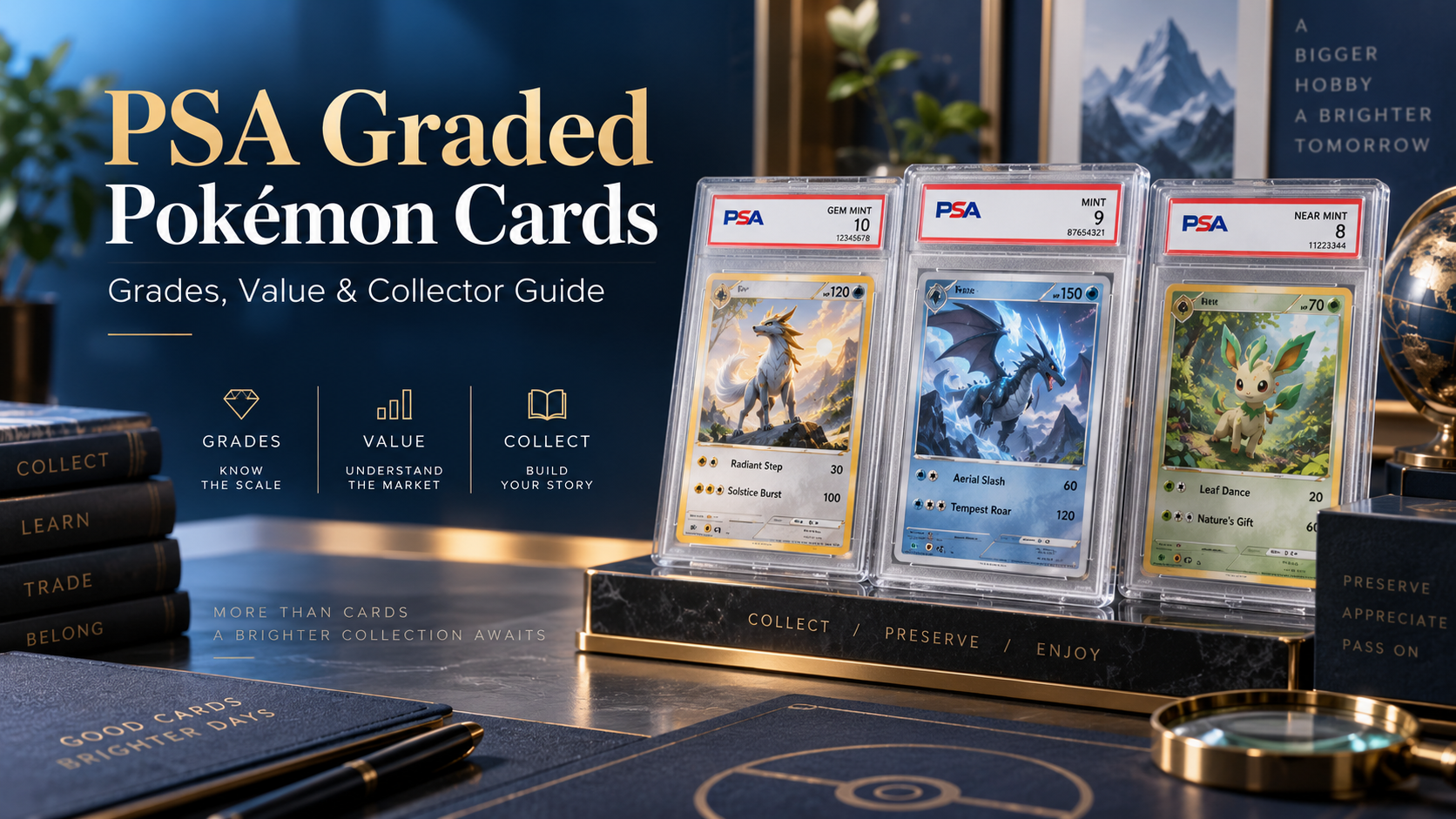
If you have spent any time browsing Pokémon cards online, you have probably seen cards sealed inside clear plastic holders with grades such as PSA 9 or PSA 10 printed on the label.
These are PSA graded Pokémon cards: cards that have been authenticated, evaluated for condition, assigned a numerical grade, and encapsulated by Professional Sports Authenticator (PSA).
For collectors, grading provides a more standardized way to understand a card's condition and compare one copy with another. It can also make authentication and long-term storage easier.
But there is one important thing every new collector should understand:
A high PSA grade does not automatically make a Pokémon card rare or valuable.
The card itself still matters.
In this guide, we'll explain how PSA grading works, what the different grades mean, what affects the value of a graded Pokémon card, and when buying graded instead of raw cards makes sense.
What Is a PSA Graded Pokémon Card?
A PSA graded Pokémon card is a card that has been submitted to PSA for professional authentication and condition grading.
Once the card has been evaluated, PSA assigns it a numerical grade and seals it inside a protective holder.
Collectors usually call this holder a slab.
The label inside the slab normally identifies the card and displays its assigned grade and certification number.
Raw Cards vs Graded Cards
A raw Pokémon card is simply a card that has not been professionally graded.
It may still be stored safely in a sleeve, top loader, binder, magnetic case, or another protective holder, but there is no third-party grade attached to it.
A graded card has been independently evaluated.
That difference can be useful because two raw copies of exactly the same Pokémon card might both be described by sellers as being in "mint condition," while their actual condition can be quite different.
One card might have stronger centering.
Another might have small scratches, edge whitening, or corner wear that is difficult to notice in photographs.
With a PSA graded card, collectors have a standardized condition grade that can make comparisons easier.
That doesn't mean every PSA card looks identical within the same grade, but it provides a much clearer reference point than a seller's subjective description alone.
How Does PSA Grade Pokémon Cards?
PSA grades trading cards on a numerical scale ranging from 1 to 10, with PSA 10 representing the highest numerical grade.
Several aspects of a card's physical condition can affect the final result.
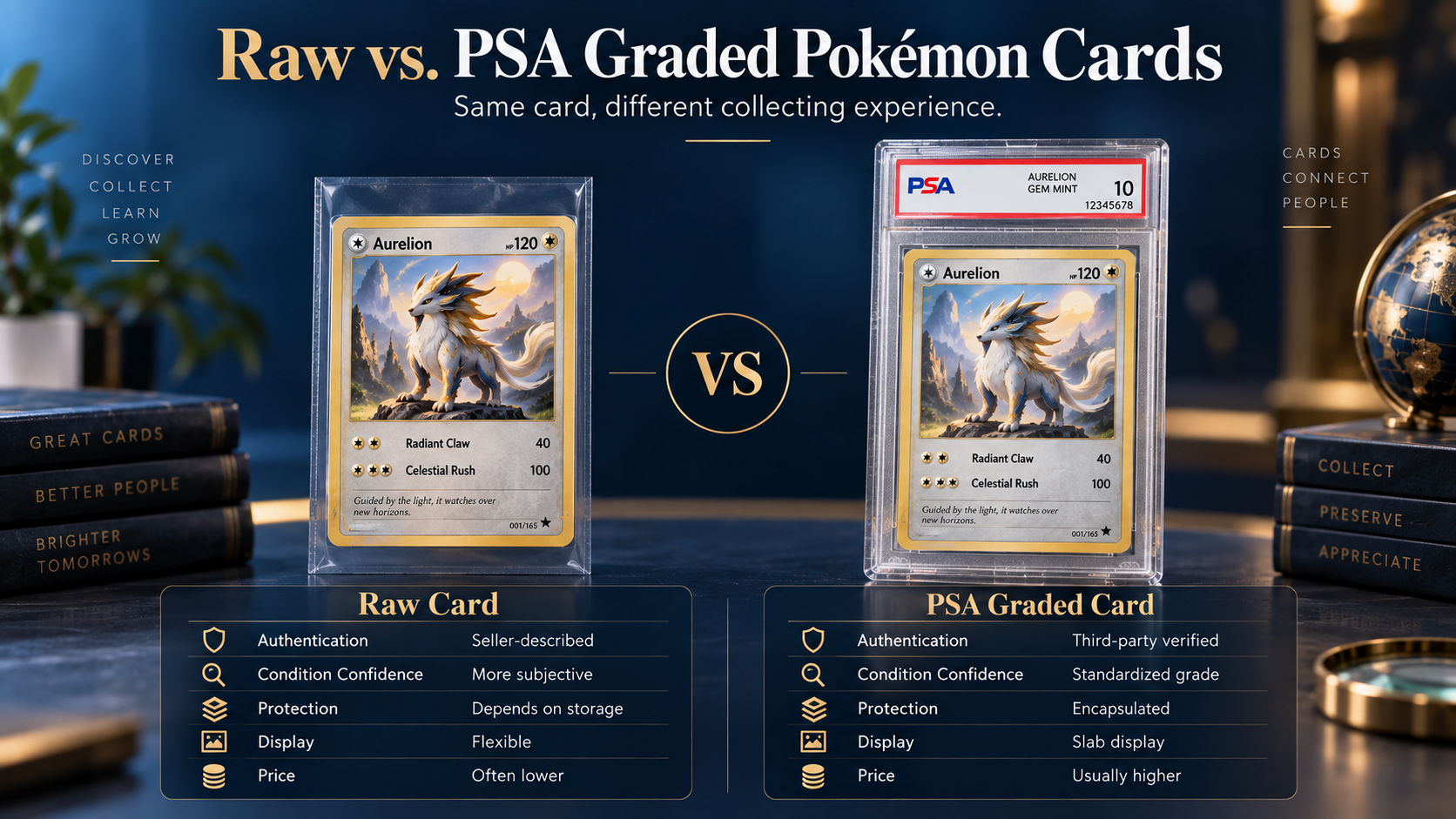
For beginners, four areas are especially important to understand.
Centering
Centering refers to how evenly the printed design sits within the borders of the card.
A card can be pulled directly from a pack and still be noticeably off-center because this can happen during manufacturing.
This is one reason a freshly opened card is not automatically a PSA 10.
Corners
Collectors generally want clean, sharp corners.
Small amounts of whitening, fraying, bending, or wear can prevent a card from receiving the highest grade.
Some corner flaws are easy to spot, while others require closer inspection.
Edges
The edges of a card can show whitening, chips, wear, or other imperfections.
Cards with darker borders can make edge wear especially noticeable.
Surface
Surface condition includes scratches, dents, stains, print defects, creases, and other imperfections on the front or back of the card.
Some surface flaws are difficult to see under normal lighting.
That's why a Pokémon card that appears nearly perfect at first glance may still receive a lower grade than its owner expected.
PSA Pokémon Card Grades Explained
PSA's grading scale runs from PSA 1 through PSA 10.
For modern Pokémon collectors, the grades you will probably encounter most often are at the upper end of the scale.
| PSA Grade | Condition | Simple Explanation |
|---|---|---|
| PSA 10 | Gem Mint | Virtually perfect condition |
| PSA 9 | Mint | Excellent condition with a minor flaw |
| PSA 8 | Near Mint-Mint | High-quality card with more noticeable imperfections |
| PSA 7 | Near Mint | Strong overall condition with visible wear or flaws |
| PSA 6 and below | Various | Increasing levels of wear or condition issues |
Why Does PSA 10 Get So Much Attention?
PSA 10 sits at the top of PSA's numerical grading scale.
For collectors who want the cleanest possible example of a particular Pokémon card, that makes PSA 10 especially attractive.
In some cases, PSA 10 copies can also be significantly less common than PSA 9 or lower-grade examples.
That scarcity can contribute to a price premium.
However, the grade still needs context.
A PSA 10 copy of a widely available card with little collector demand can be worth much less than a PSA 8 or PSA 9 copy of a genuinely scarce and desirable card.
The easiest way to remember it is:
The grade describes the condition of the card. It does not create rarity by itself.
We'll explore this difference in more detail in our PSA 9 vs PSA 10 guide.
What Makes a PSA Graded Pokémon Card Valuable?
One of the most common mistakes new collectors make is looking at the number on the slab before looking at the card inside it.
The PSA grade matters, but it is only one part of the value equation.
Several factors can influence how desirable a graded Pokémon card becomes.
1. The Pokémon
Some Pokémon have much larger collector followings than others.
Characters such as Pikachu and Charizard have decades of history and large fan bases, which can create strong demand for certain cards.
But the character alone does not determine value.
There are many inexpensive Pikachu and Charizard cards alongside significantly rarer releases.
The exact card always matters.
2. The Set and Release
Collectors often distinguish cards by:
- Set
- Year
- Language
- Card number
- Artwork
- Promotional release
- Distribution method
- Special variant
Two cards featuring the same Pokémon can have completely different rarity and collector demand.
3. Rarity and Availability
Some Pokémon cards were produced or distributed in much smaller numbers than others.
Examples can include limited promotional cards, event releases, difficult pulls, and cards with unusual distribution histories.
But rarity alone isn't enough to guarantee value.
A card can be extremely scarce and still have limited demand.
The strongest collectible markets usually combine:
scarcity + collector demand
4. Condition and PSA Grade
Once collectors have decided they want a particular card, condition becomes much more important.
For the exact same release, a cleaner copy will usually be more desirable than a heavily worn example.
Professional grading provides a standardized way to describe that difference.
5. PSA Population
Collectors may also look at a card's PSA population.
This tells you how many examples PSA has graded at different levels.
For example, a card with thousands of PSA 10 copies has a different condition-scarcity profile from a card with very few Gem Mint examples.
Population data still needs context.
A low population doesn't automatically mean a card is valuable if very few people want it.
6. Collector Demand
Ultimately, collectible markets exist because people want particular cards.
Demand can come from:
- Nostalgia
- Artwork
- Pokémon popularity
- Historical importance
- Set popularity
- Promotional history
- Scarcity
- Collecting trends
This is why there is no reliable formula that says:
PSA 10 = a specific dollar value.
The card comes first.
The grade comes second.
Are PSA 10 Pokémon Cards Always Valuable?
No.
This is one of the most important things to understand about graded Pokémon cards.
A PSA 10 tells you about the condition of that particular copy.
It does not tell you how rare the underlying card is or how many collectors want it.
Imagine two hypothetical cards.
The first was printed in very large numbers and has limited collector demand.
The second is an older promotional release that collectors actively search for.
Even if the first card receives PSA 10 and the second receives PSA 9, the PSA 9 card could still be significantly more valuable.
A useful collecting rule is:
Choose the card first. Evaluate the grade second.
A high grade can make an already desirable card even more attractive, but it cannot make every Pokémon card valuable.
Raw vs Graded Pokémon Cards: Which Should You Buy?
There is no universal winner.
Raw cards and PSA graded Pokémon cards serve different types of collectors.
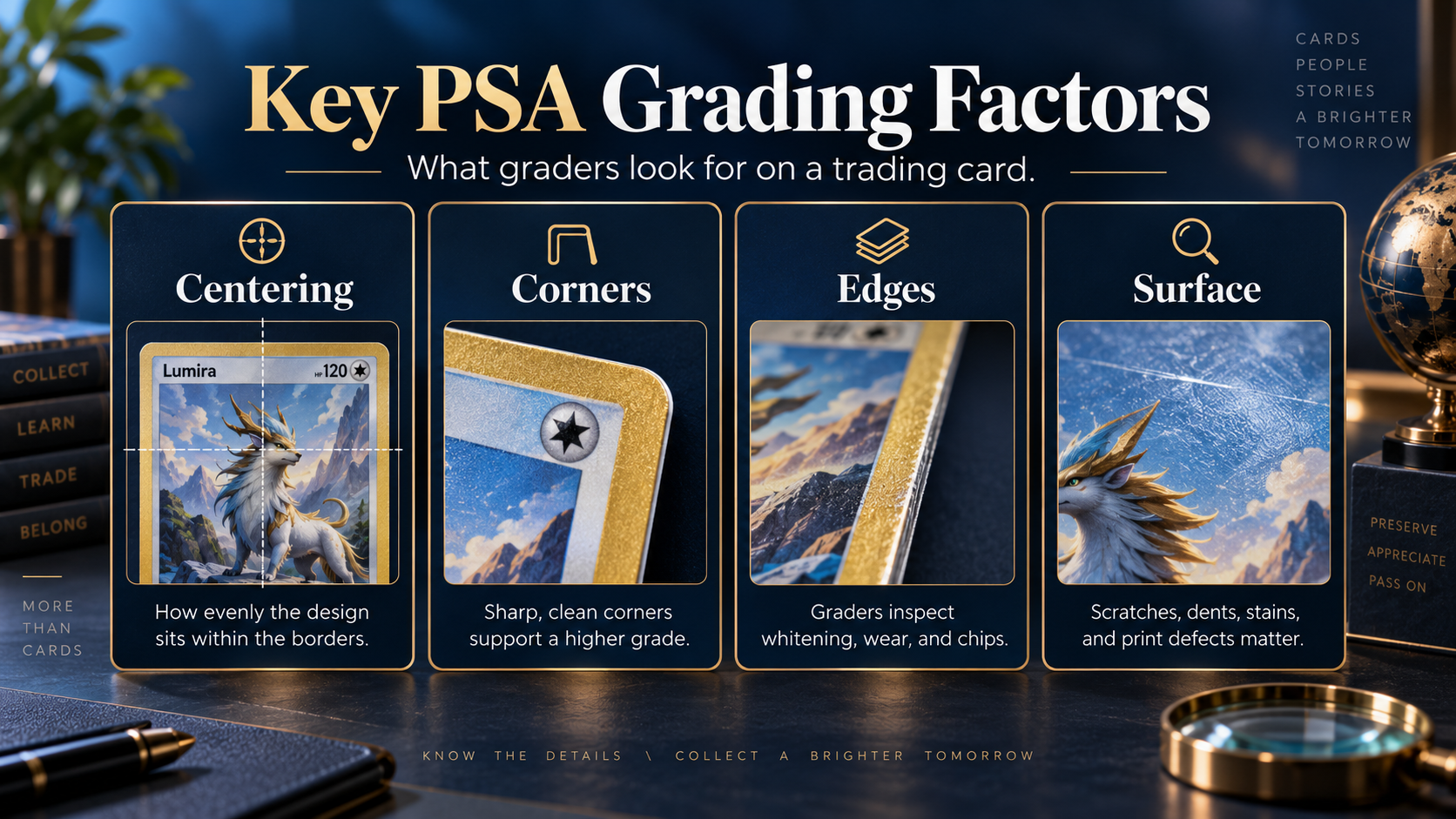
| Factor | Raw Pokémon Cards | PSA Graded Pokémon Cards |
|---|---|---|
| Initial price | Often lower | Often higher |
| Condition assessment | Buyer evaluates it | Third-party grade |
| Authentication | Depends on seller and card | Professional authentication process |
| Protection | Depends on storage | Encapsulated holder |
| Binder collecting | Excellent | Not practical |
| Display | Flexible | Standard slab format |
| Comparing copies | More subjective | Easier using grades |
When Raw Pokémon Cards Make Sense
Raw cards can be ideal if you:
- Enjoy building binders
- Want lower-cost collecting options
- Prefer handling your cards
- Mainly collect artwork or characters
- Plan to submit cards for grading yourself
You do not need a slab around every Pokémon card to have a serious collection.
When Graded Pokémon Cards Make Sense
Graded cards may be more attractive if you care about:
- Standardized condition
- Third-party authentication
- Long-term physical protection
- Displaying favorite cards
- Comparing different copies
- Collecting specific grades
Many collectors use both approaches.
They may keep most of their collection raw while purchasing graded examples of cards that are especially important to them.
PSA vs Other Pokémon Card Grading Companies
PSA is not the only company that grades Pokémon cards.
Another major grading company collectors often encounter is CGC.
Cards graded by PSA and CGC can look similar in concept—a professionally evaluated card sealed inside a protective holder—but the companies use their own grading standards, labels, holders, and grading systems.
That means you should not automatically assume that:
CGC 10 = PSA 10
simply because both slabs display the number 10.
Collectors may also have different preferences depending on the card, category, slab design, grading company, and resale market.
We'll cover this topic separately in our full PSA vs CGC comparison.
For now, the important rule is simple:
Always check which grading company issued the grade before comparing two graded cards.
How to Verify a PSA Graded Pokémon Card
PSA graded cards include a certification number that can be checked through PSA's official certification verification system.
When checking a graded card, compare the certification information with the slab in front of you.
Important details can include:
- Pokémon name
- Set
- Year
- Card number
- Variant
- Assigned grade
However, certification lookup should not be your only protection when buying expensive cards.
A certification number can potentially be copied from a legitimate slab and placed on a counterfeit label or holder.
For higher-value purchases, also consider:
- Seller reputation
- Detailed photographs
- Slab condition
- Label accuracy
- Purchase protection
- Trusted marketplaces or dealers
Authentication is a process, not just a number lookup.
What Types of Pokémon Cards Do Collectors Get Graded?
Almost any authentic Pokémon card can potentially be submitted for grading.
But because grading costs money, collectors are usually selective.
Cards commonly considered for grading include:
Vintage Pokémon Cards
Older cards in unusually strong condition can be particularly appealing to graded-card collectors.
With vintage cards, finding well-preserved copies can become increasingly difficult over time.
Pikachu Cards
Pikachu has one of the largest collector followings in the Pokémon hobby.
Collectors may grade everything from nostalgic vintage Pikachu cards to Japanese promotional releases and modern special-art cards.
If Pikachu is your main collecting focus, we'll cover this topic separately in our guides to rare Pikachu cards and Pikachu PSA 10 cards.
Charizard Cards
Charizard remains one of the most recognizable Pokémon in the trading card hobby.
Many different Charizard releases have been graded over the years, ranging from vintage cards to modern chase cards.
Japanese Promotional Cards
Japan has produced many Pokémon promotional cards tied to events, products, locations, campaigns, and special releases.
Some of these cards have developed strong collector followings.
Modern Chase Cards
Modern Pokémon sets also contain cards that collectors actively search for in high grades.
Artwork, pull rates, character popularity, and set popularity can all influence which cards people choose to grade.
How Do Collectors Buy PSA Graded Pokémon Cards?
There are several ways to acquire graded Pokémon cards.
Card Shops and Dealers
Dedicated card stores and dealers can be a good option for collectors who want to inspect specific inventory.
Specialist sellers may also have more experience identifying unusual releases and variants.
Online Marketplaces
Online marketplaces provide access to enormous numbers of graded cards.
The selection is hard to match, but collectors should pay close attention to:
- Seller reputation
- Card photographs
- Certification details
- Return policies
- Recent comparable sales
Auctions
Auctions can be useful for harder-to-find cards and higher-end collectibles.
They can also provide useful information about what collectors have recently been willing to pay for particular cards.
Collectible Mystery Boxes
Another option is the collectible mystery-box format.
Unlike buying a specific PSA slab from a dealer, the exact card received is not selected in advance.
That makes the experience fundamentally different from traditional card shopping.
Before participating, collectors should understand the box price, current prize pool, possible outcomes, and applicable rules.
Explore a Graded Pokémon Card Box
For collectors who enjoy the mystery-box format, HapaBox PSA GRADED CARD offers another way to discover professionally graded Pokémon cards.
The box can feature graded Pokémon cards across different characters, sets, grades, and grading companies.
Because mystery-box inventories can change over time, always review the current prize pool and box details before participating.
Explore the PSA Graded Card Box →
Are PSA Graded Pokémon Cards Worth Collecting?
They can be, but the answer depends on what you want from the hobby.
For Beginners
If you are just getting started with Pokémon cards, you do not need to immediately build a large PSA collection.
Buying raw cards can be an inexpensive way to discover which Pokémon, sets, artwork, and eras you actually enjoy.
For Display Collectors
Slabs provide a consistent display format and physical protection.
If you enjoy displaying individual favorite cards, graded cards can be very appealing.
For Condition-Focused Collectors
A numerical grade makes it easier to compare the condition of different copies.
This can be particularly useful when collecting older or more valuable cards.
For Value-Focused Collectors
Grading can make comparable sales easier to identify because buyers can compare the same card at the same grade.
However, grading does not guarantee that a card will increase in value.
Collector demand, supply, market conditions, and trends can all change.
A better approach is to buy:
A card you actually want, in a grade you are comfortable owning, at a price you are comfortable paying.
6 Tips for Buying Your First PSA Pokémon Card
1. Buy the Card, Not Just the Grade
A PSA 10 label can be exciting, but make sure you actually want the Pokémon card inside the slab.
Character, artwork, set, and release should matter more than the number alone.
2. Identify the Exact Card
Before comparing prices, make sure you're looking at the same:
- Year
- Set
- Language
- Card number
- Variant
- Grade
Two similar-looking Pokémon cards may actually be completely different releases.
3. Verify the Certification
Check the PSA certification information and make sure it matches the card and grade shown on the slab.
4. Compare Like With Like
If you want to understand recent pricing, compare a PSA 9 with recent PSA 9 examples of the same card.
Do not compare it with another release simply because it features the same Pokémon.
5. Use Population Data in Context
Population data can help you understand how many cards have received a particular grade.
But low population only becomes meaningful when there is also real collector demand.
6. Don't Assume PSA 10 Means Rare
A card can have thousands of PSA 10 copies.
Always investigate the underlying card before paying a premium for the grade.
FAQ About PSA Graded Pokémon Cards
Are PSA graded Pokémon cards worth more than raw cards?
Sometimes, but not automatically.
A desirable card in a strong grade may command a premium over a comparable raw copy, but card rarity, demand, condition, and market activity all matter.
Grading alone does not guarantee additional value.
Is PSA 10 the highest grade for Pokémon cards?
Yes. PSA 10 Gem Mint is the highest numerical grade on PSA's card grading scale.
It represents a card PSA considers virtually perfect under its grading standards.
Is PSA 9 still a good grade?
Yes.
PSA 9 represents Mint condition and can be an attractive option for collectors who want a high-quality card without paying the premium sometimes associated with PSA 10.
We'll explore the trade-offs in our full PSA 9 vs PSA 10 guide.
Is PSA better than CGC for Pokémon cards?
There is no universal answer.
Both grading companies have their own systems, holders, labels, and collector followings.
The better option can depend on the specific card and your collecting priorities.
See our PSA vs CGC guide for a detailed comparison.
How can I check whether a PSA Pokémon card is legitimate?
Start by checking the certification number through PSA's official verification system and comparing the information with the card and slab.
For expensive cards, also consider seller reputation, detailed photographs, purchase protection, and the physical characteristics of the slab.
Should beginners buy raw or graded Pokémon cards?
Either can work.
Raw cards are often better for lower-cost collecting and binders, while graded cards can be useful for collectors who prioritize authentication, standardized condition, protection, and display.
Are all PSA 10 Pokémon cards expensive?
No.
PSA 10 describes condition.
It does not tell you how rare the card is or how much collector demand exists.
A common card can still receive PSA 10.
Final Thoughts
PSA grading gives Pokémon collectors a standardized way to authenticate cards, describe condition, protect individual collectibles, and compare one copy with another.
But the number printed on the slab should never become more important than the Pokémon card inside it.
Remember:
Grade, rarity, and value are three different things.
A PSA 10 card can be highly desirable, but a high grade alone does not guarantee rarity or value.
If you're new to graded Pokémon cards, start with the cards and characters you genuinely enjoy. From there, grading becomes another tool for choosing the condition, presentation, and collecting style that works for you.
Continue Learning
- PSA 9 vs PSA 10: What's the Difference?
- PSA vs CGC: Which Card Grading Service Is Better?
Explore Graded Pokémon Cards
Interested in a mystery-box-style graded card experience?